Best Pens for Note Taking: 11 Picks That Survive Class

I have thrown away more pens mid-semester than I care to admit, which is how I learned that the best pens for note taking aren’t the ones that feel nicest in the shop. They’re the ones that survive a three-hour lecture, a highlighter dragged over the top, and a week at the bottom of a bag.
Between a Master’s worth of lecture notes and years of planning my week longhand, I’ve had the smudged pages, the pen that died in week three, and the fine tip that shredded itself on cheap paper.
Which pen suits you also depends on the note-taking method you use, because a page of fast linear notes and a tightly ruled table ask completely different things of a tip.
This guide covers how the ink types actually differ, the 11 pens I’d pick and what each one is bad at, which pen suits which kind of note-taking, and why your paper matters as much as your pen.
Some links in this guide are affiliate links. As an Amazon Associate, I earn from qualifying purchases, at no extra cost to you.
What are the best pens for note taking?
If you want one answer and no shopping, take the Uni-ball Jetstream RT. It was the most-recommended pen in everything I read for this post, named in four of the seven guides I studied and again and again by people on Reddit who write all day, and its fast-drying hybrid ink, a ballpoint-gel cross, is the safest choice if you’re left-handed.
Here’s the whole shortlist, with the honest catch on each one.
| Pen | Best for | The catch |
|---|---|---|
| Uni-ball Jetstream RT | Everyday speed, and left-handers | Firmer and drier under the hand than a gel |
| Pentel EnerGel RTX | Gel feel without the wet page | Drinks ink faster than a ballpoint |
| Pilot G2 | Replacing a lost pen anywhere, today | Enthusiasts rate several gels above it |
| Uni-ball Signo DX 0.38 | Small handwriting and cramped margins | Catches on cheap, toothy paper |
| Zebra Sarasa Dry | Writing fast and dragging your hand across | Trades a little glide for dry time |
| Pilot Acroball | Budget multipacks, safe under a highlighter | A workhorse, not a joy |
| Sharpie S-Gel | Long sessions and hand fatigue | A chunky barrel isn’t for everyone |
| Pilot Precise V5 | Crisp, deliberate fine lettering | Slow to dry, so bad news for lefties |
| Sakura Pigma Micron | Annotation and notes you want to keep | An art pen, and it wears like one |
| Muji Gel Ink Ballpoint | A plain, minimalist everyday pen | Patchy availability outside Muji |
| Pilot FriXion | Planners and colour-coding | Erasable ink is not a permanent record |
Gel, ballpoint, rollerball or fineliner?
Four families cover almost every pen you’ll pick up, and the differences between them are physical rather than marketing.
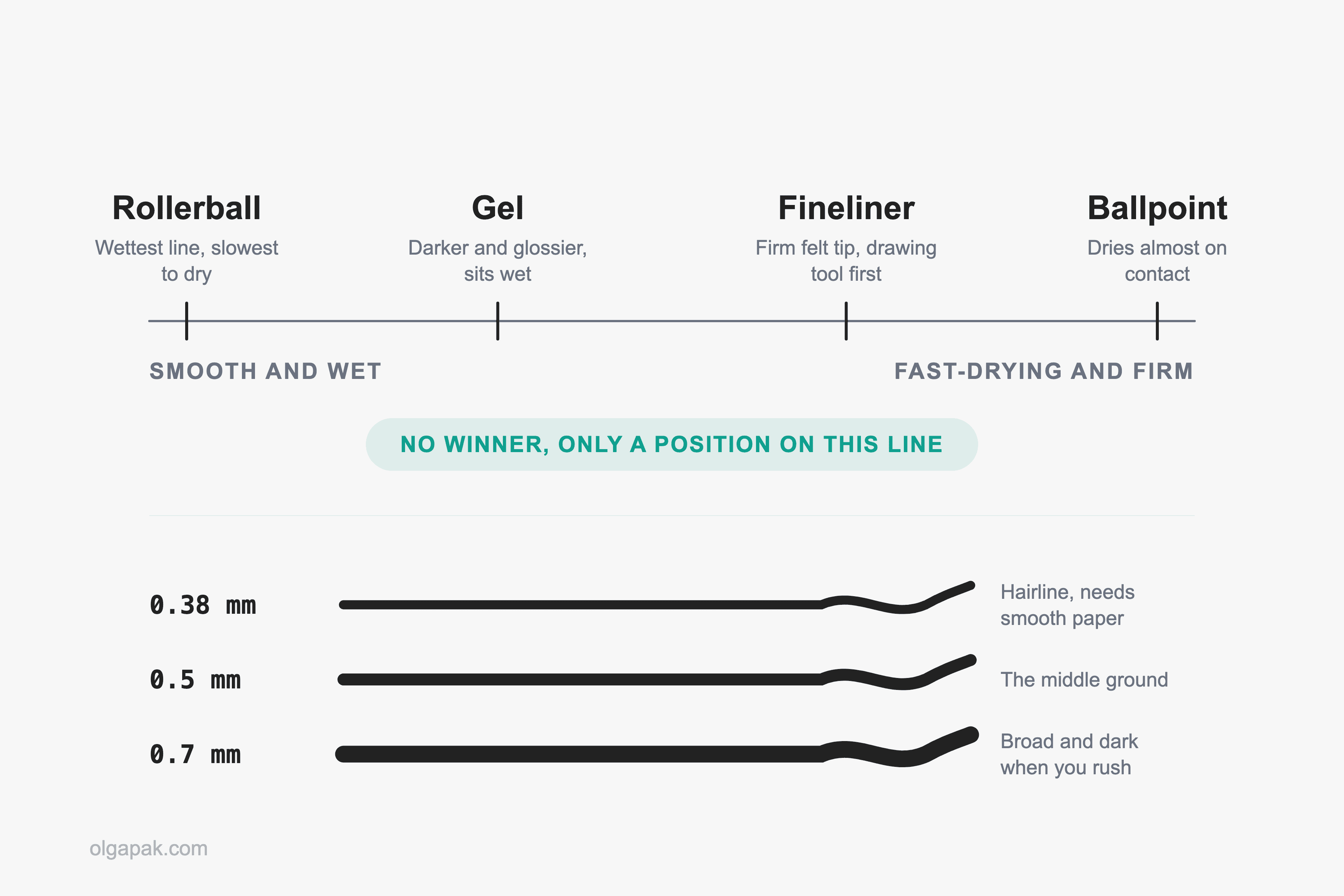
- Ballpoint (including hybrids like the Jetstream): thick, oil-based ink pushed onto the page by a rolling ball. Firm under the hand, wants a little pressure, and dries almost the instant it lands.
- Gel: water-based ink with pigment suspended in it. Darker, glossier, smoother to write with, and it sits wet on the page a moment longer.
- Rollerball: liquid ink, the wettest of the four, and the crispest fine line. Also the slowest to dry.
- Fineliner: a plastic or felt tip with no ball in it at all. It came out of drawing and drafting, and it still behaves like it.
Which family should you actually want?
There isn’t a winner, there’s a trade-off. Ballpoint ink dries essentially on contact, which is why it resists smudging and why left-handed writers tend to end up there. Gel sits wet longer, and gel also empties a pen faster because it lays down more ink per line. That’s the reason ballpoints last the longest, as one r/pens commenter put it while recommending them to a broke student.
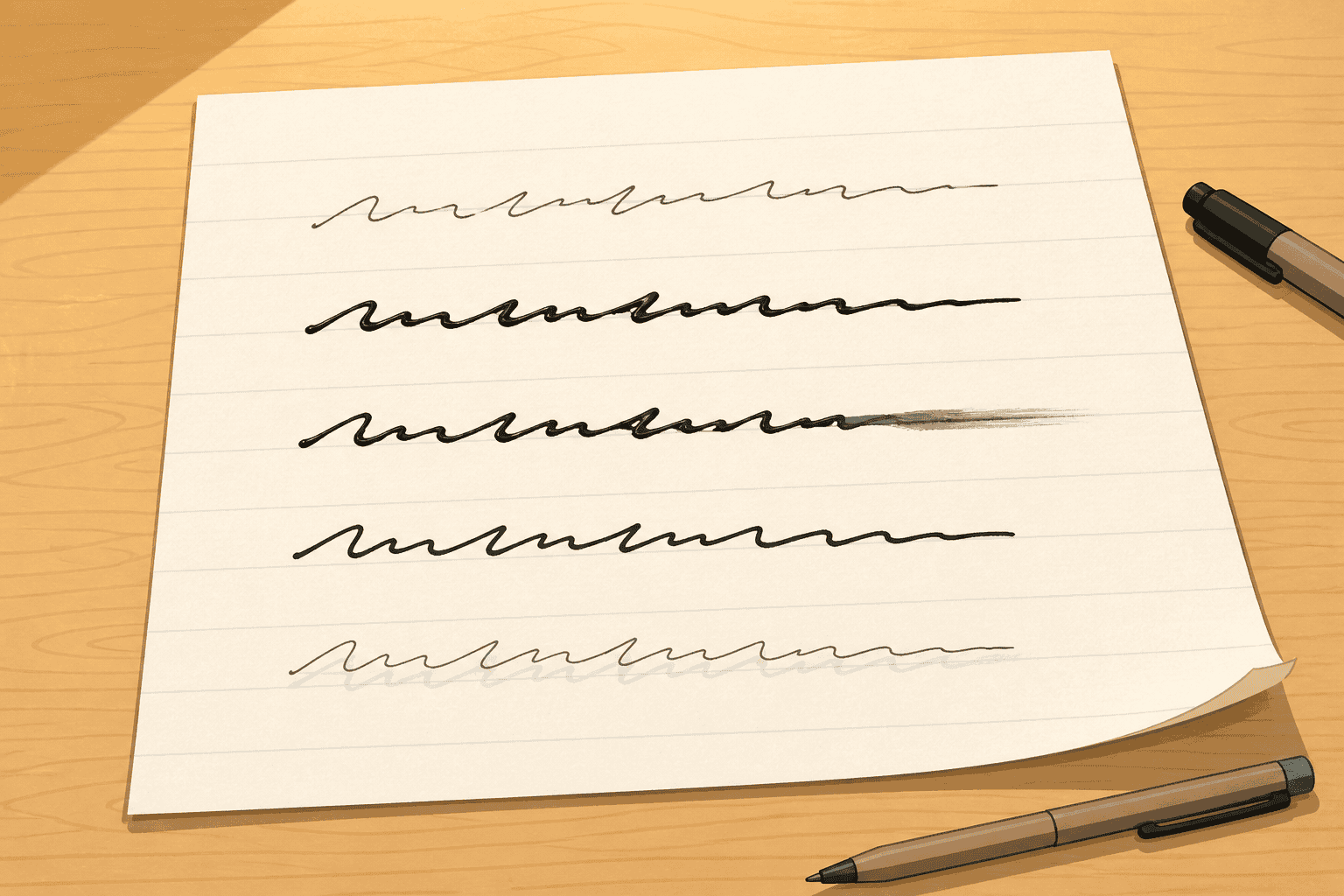
Gel has its own conditions. It performs best on smooth paper and can look uneven and blotchy on rougher, cheaper stock, which matters more than most roundups admit.
Say it plainly: smooth and wet pull one way, fast-drying and firm pull the other. You do not get both in the same pen, and every pick below is just a position on that line.
Tip size is the other thing people get wrong. The three widths that matter for note-taking are 0.38, 0.5 and 0.7 mm, and they describe your handwriting and your paper, not quality. A 0.38 lays a hairline that fits between printed textbook lines and looks terrible on fluffy paper. A 0.7 lays a broader, darker, wetter line that stays legible when you’re rushing. A 0.38 is not better than a 0.7. It’s narrower.
The 11 best pens for note taking
Every pick below follows the same shape: what it’s best at, why it earns the spot, the honest catch, and who should skip it. No pick here is perfect, and a roundup that pretends otherwise is selling you something.
Uni-ball Jetstream RT, best overall
Best for: everyday note-taking at speed, and the safest pick if you’re left-handed.
No other pen in my research came close on sheer weight of recommendation, from the expert roundups down to the Reddit threads where people write all day. The draw is its fast-drying hybrid ink: ballpoint reliability with something closer to a gel’s darkness, which is a rare combination to get in a pen you can buy in a twelve-pack.
The catch: it is still a ballpoint underneath. It feels firmer and less juicy than a good gel, and people who love gel find it a small step down in feel.
Skip if: you want saturated, glossy gel lines on the page.
Pentel EnerGel RTX, best smudge-resistant gel
Best for: gel feel without the wet-page problem.
Pen Addict ranks it above the Pilot G2, which is not a small thing given the G2’s sales dominance. And in the r/pens thread where a student was burning through pens on class notes, the top comment named the EnerGel LRN-5 as the refill to buy.
The catch: it is still a gel, so over a full semester it drinks ink faster than any ballpoint on this list.
Skip if: you don’t want refills to be a thing you think about.
Pilot G2, best gel you can actually find anywhere
Best for: the pen you can replace in any supermarket, mid-semester, without planning ahead.
Ubiquity is the honest reason it’s here, not superiority. Pen Addict devotes space to explaining why the G2 is not on its top-five list despite outselling everything, and I think that’s a fair read.
The catch: enthusiasts consistently rate several gels above it, and it can smudge if your hand catches the line before it dries.
Skip if: you have five minutes to order something better.
Uni-ball Signo DX 0.38, best ultra-fine tip
Best for: small handwriting, cramped margins, and annotating between printed lines.
Pen Addict calls the Signo DX 0.38 “the micro gel ink pen I compare all others to”, and it keeps its position year after year on that list. If your writing is small, a hairline tip stops it collapsing into an unreadable smear. One practical note: the Signo name travels badly. In the US the same micro gel sells as the uniball 207 in a 0.38 mm ultra micro point, and the DX branding mostly turns up on Japanese imports and refills, so buy on the tip size rather than the name.
The catch: a tip that fine catches on toothy, cheap paper and can feel scratchy rather than smooth.
Skip if: you write big, press hard, or work in budget refill pads.
Zebra Sarasa Dry, best fast-drying gel
Best for: writing quickly and dragging your hand straight across the line you just wrote.
It shows up in two of the roundups I studied, and the Reddit student threads recommended it twice, independently, with one commenter pairing the Sarasa Grand 0.7 with a heavier, smoother paper.
The catch: fast-drying gel formulas buy that dry time with a little smoothness. It doesn’t glide quite like a wetter gel.
Skip if: glide matters more to you than dry time.
Pilot Acroball, best budget ballpoint
Best for: buying a multipack and not thinking about pens again this term. It’s also the safe pick under a highlighter.
It’s a low-viscosity ballpoint, which is a technical way of saying the ink is runnier than old-school biro ink and needs less pressure. Reddit backs it as the budget-durable option: “Ballpoints last the longest, so that makes them budget friendly. Uni Jetstream or Pilot Acroball will be great”, wrote u/StillPissed.
The catch: it’s a workhorse, not a joy. Nobody describes writing with one as a pleasure.
Skip if: you want the act of writing itself to feel good.
Sharpie S-Gel, best grip for long sessions
Best for: three-hour lectures, exam revision, anything where your hand gives out before your notes do.
When a university student asked r/pens for something comfortable and affordable for copious note-taking, the most-upvoted answer steered away from slim iconic pens and toward something with a much more substantial and tactile grip section, naming the S-Gel as the affordable way to get it.
The catch: a chunkier barrel is a personal thing. The same grip other people love can feel bulky in a smaller hand.
Skip if: you prefer a slim pen you can forget you’re holding.
Pilot Precise V5, best rollerball for fine lettering
Best for: crisp, consistent fine lines when you want your notes to look deliberate rather than fast.
It’s Wirecutter’s pick for fine lettering, and liquid ink is genuinely different to write with: no pressure needed, no waxy drag, just a clean dark line.
The catch: it is explicitly slow to dry. That’s the one hard warning in this whole list.
Skip if: you’re left-handed. I’m not burying this in a footnote. Your hand will drag through wet ink on every line and the page will be a mess by the end of the lecture.
Sakura Pigma Micron, best for annotating and keeping
Best for: margins, textbook annotation, and notes you want to still be legible years from now.
It’s the standard fineliner recommendation, and the reason is the ink. Sakura describes Pigma as a permanent, fade resistant, chemically stable, pigment-based ink, and lists archival journals and record keeping alongside illustration as what it’s for.
The catch: and this is the sharpest thing in this post. The tip is the problem, not the ink. People who use these for sustained note-taking post side-by-side photos of points visibly destroyed after a single day. The top comment on one of those threads is blunt: “These pens aren’t really designed well for sustained note taking. If you really want to use them for that, try pressing less hard and using smoother paper.”
To be fair, long-time users in the same thread report years of use out of the same pens. Pressure is the variable, not the pen.
Skip if: this is your only pen and you write hard and fast.
Muji Gel Ink Ballpoint, best minimalist everyday pen
Best for: a plain, unbranded pen that writes cleanly and is easy to re-buy in exactly the same size.
Muji’s appeal here is what it leaves out: a plain barrel, a line that doesn’t get restyled every couple of seasons, just a pen people keep going back to because it stays the same one they liked last year. It is genuinely gel ink, it comes in fine sizes down to 0.3 mm, and Muji sells refills for it separately, which matters more than it sounds when your favourite pen runs dry in week nine.
The catch: availability is patchy outside Muji’s own stores and website.
Skip if: you need to restock from a supermarket at short notice.
Pilot FriXion, best erasable pen for planners
Best for: planners, colour-coding, and anything you fully expect to change your mind about.
It’s the erasable pick from the planner-community roundup in my research set, and for a weekly layout that gets rearranged twice before Wednesday, being able to lift a line cleanly is worth more than a perfect writing feel.
The catch: erasable ink is erasable. That is the feature and the flaw, and it means this is not the pen for anything that has to survive as a permanent record.
Skip if: the notes are a record you’ll need later: exams, signatures, anything legal.
Which pen for which kind of note-taking
The picks above, sorted by what you’re actually doing with them. If you’re buying pens as a present, the Jetstream multipack also made my list of gift ideas for students.
| What you’re doing | Pick | Why |
|---|---|---|
| Fast lecture notes | Uni-ball Jetstream RT | Dry time beats smoothness when your hand is already on the next line |
| Writing left-handed | Jetstream RT or Pilot Acroball | Ballpoint ink is dry before your hand reaches it. Avoid the Precise V5 entirely here |
| Three-hour sessions, sore hand | Sharpie S-Gel | A wider grip section spreads the pressure instead of concentrating it |
| Annotating printed pages | Sakura Pigma Micron | A fine pigment tip fits between printed lines without spreading into them |
| Colour-coding a planner | Pilot FriXion | Erasable colour suits a layout you keep revising, like the Cornell method’s cue column |
| Tight table cells and small boxes | Uni-ball Signo DX 0.38 | A hairline keeps the charting method’s tight table cells readable at speed |
| Buy once, forget about it | Pilot Acroball multipack | Ballpoints last longest per pen, which is exactly what makes them the budget choice |
One caveat on the comfort row, because comfort is where real note-takers disagree most. In a single r/pens thread, one commenter wrote that “for notes a Parker Jotter sucks, imho. It’s an iconic, but old design. It’s not ergonomic”, and a left-hander replied that they’d used the same pen for more than four hours a day for a year with no problems. That’s why there’s a grip-focused option on this list rather than a single declared winner.
Your paper matters as much as your pen
A pen that bleeds through one notebook can behave perfectly in the next. Same pen. Different paper.
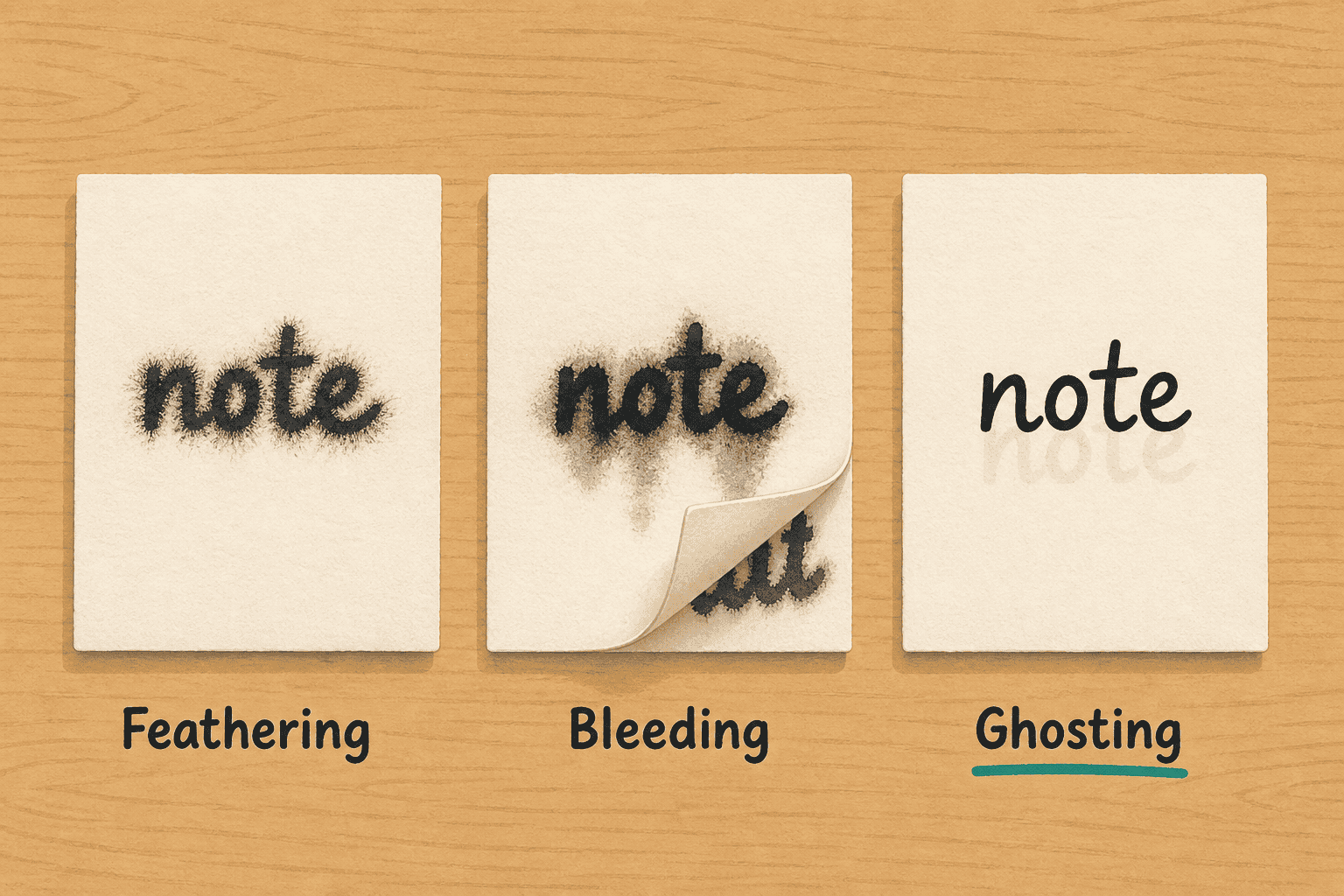
Three words do most of the work here, and people mix them up constantly. The cleanest definition I found came from an r/notebooks commenter: “This is called feathering. Bleed is going through the paper. Not to be confused with ghosting where you can see it through the page but hasn’t soaked through.”
Which one is actually happening on your page, though?
- Feathering: the ink creeps sideways out of the letter’s edges, so your writing looks furry.
- Bleeding: the ink soaks right through to the next page.
- Ghosting: you can see the writing through the page, but it hasn’t come through. Annoying, not fatal.
Now the myth. Paper weight, measured in gsm (grams per square metre), is a bad predictor of any of this. The thread that made the point best compared a cheap 70 gsm notebook against a lovely 100 gsm one, and it was the expensive one that bled. As another commenter put it, it has “absolutely nothing to do with thickness and more to do with coating and overall paper quality and material”.
One more pairing rule, and it’s the one that catches people out at revision time: water-based highlighter ink reacts with water-based pen inks, which covers gel, rollerball and fountain pens. That’s the whole reason the highlighter-safe picks above earn their spot. If you highlight as much as I do, I ranked the best highlighters for studying by the same rule.
Pick the pen you like, then pick the notebook you pair it with to suit it. If a pen you love is bleeding, change the paper before you change the pen.
The honest limits nobody mentions
What does a list like this actually leave out?
Four things I’d want a friend to tell me before I spent anything.
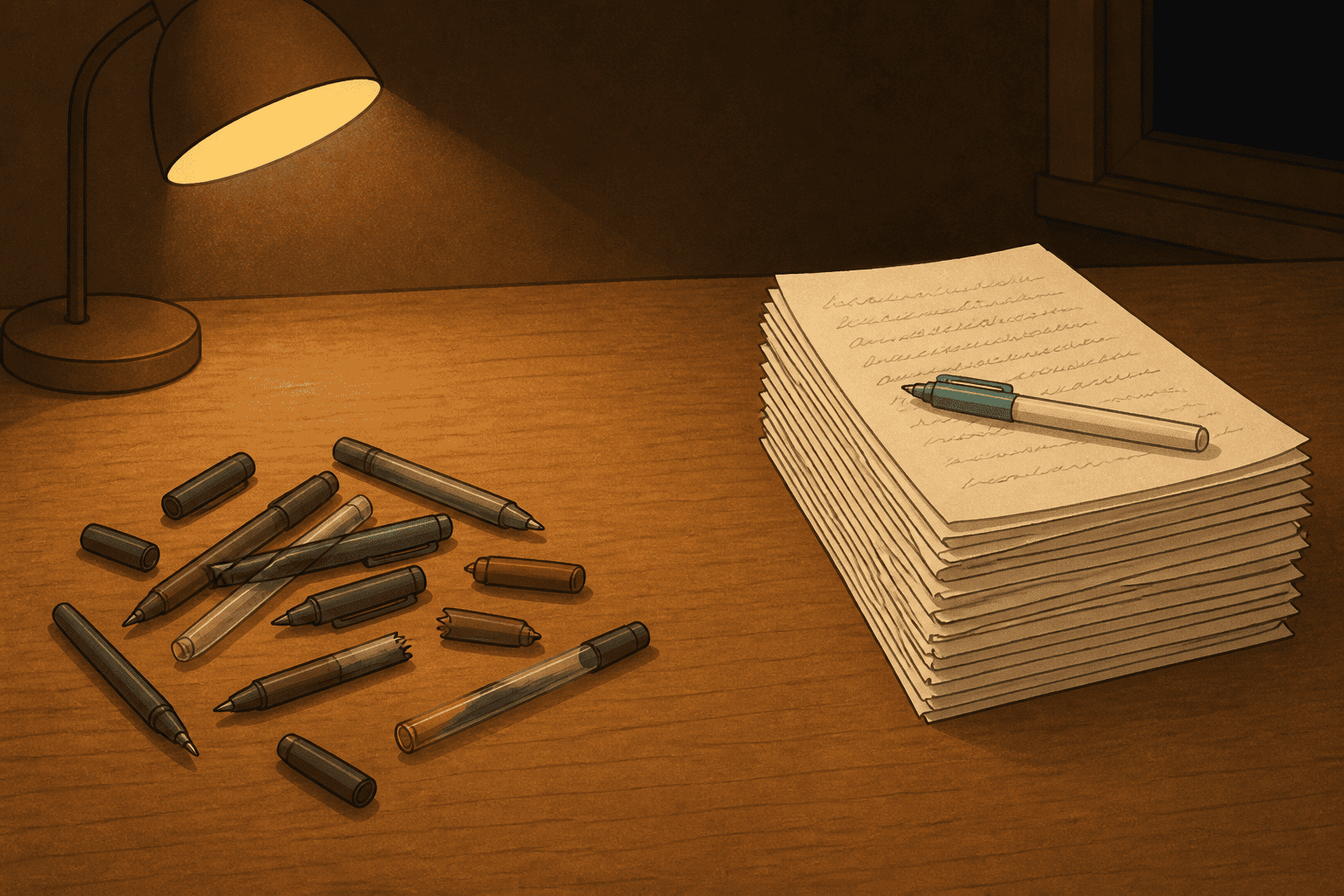
- Gel pens really do run out fast, and that’s not a defect. When a student posted that they’d killed three gel pens in a month of class notes, the top reply was direct: “No gel pen will last with the amount of note taking you do. And that’s normal. If you want gel, you need to carry refills and quickly swap them.” Ballpoints outlast gels because they lay down less ink. If that trade bothers you, buy refills or switch families.
- Fineliners are art tools first. Recommending one as an all-day note-taking pen is the most common mistake in this whole category, and it’s why the Micron entry above carries the warning it does.
- “Smooth” and “fast-drying” are pulling against each other. Any roundup promising both in one pen is skipping the physics.
- Consensus is thinner than these lists make it look. The right pen depends on how hard you press, how big you write, what paper you write on, and whether you’re left-handed. Everything above is a starting point, not a verdict.
Turn the notes into something you can revise from
Once the notes exist on paper, the next problem shows up: a term’s worth of them, and no time to reread the lot.
Try my free AI tools to automate the mundane part of that. Type up the messy section, and the Text Summarizer hands back a short, scannable version you can actually revise from, while the Acronym Explainer decodes the shorthand you scribbled at speed and can no longer read.
And if the pens are only the start and you’re kitting out the rest of the desk, here’s the aesthetic stationery worth buying, downsides included.
FAQ
What is the best pen for taking notes fast?
A fast-drying pen beats a smooth one when you’re genuinely writing at speed. The Uni-ball Jetstream RT or a quick-drying gel like the Zebra Sarasa Dry are the safest picks, because the failure you’ll hit at speed isn’t a scratchy line, it’s your hand dragging across ink that hasn’t set yet. Dry time is the variable that decides whether a page stays readable.
Which pens are best for left-handed note takers?
Ballpoints and fast-drying gels. Left-handed writers push their hand across the line they just wrote, so anything that stays wet gets smeared into the page. The Uni-ball Jetstream RT and the Pilot Acroball are the two easiest recommendations. Avoid slow-drying rollerballs like the Pilot Precise V5, which is a lovely pen and completely wrong for this job.
Do gel pens really run out faster than ballpoints?
Yes, and it’s normal rather than a fault. Gel lays down more ink per line than ballpoint ink does, so a heavy note-taker will empty gel pens noticeably faster. The fix is to carry refills and swap them, or to move to a ballpoint or hybrid pen, not to hunt for a magically longer-lasting gel.
Why does my pen bleed through the page?
Usually the paper, not the pen. Paper weight in gsm is a poor predictor of bleed-through, because sizing and coating matter far more than thickness, which is why an expensive heavy notebook can still bleed while a cheap one doesn’t. Also check what you’re actually seeing: bleeding means the ink soaked through, while ghosting just means you can see it faintly from the other side.
Are fineliners like the Sakura Pigma Micron good for note taking?
They’re excellent for annotation and for notes you want to keep, thanks to their archival pigment ink and precise fine tip. But they’re art pens by design, and heavy daily use visibly wears the tip down. If you want one to last, write with light pressure on smooth paper, and don’t make it your only everyday pen.