11 Best Highlighters for Studying in 2026 (by Study Job)

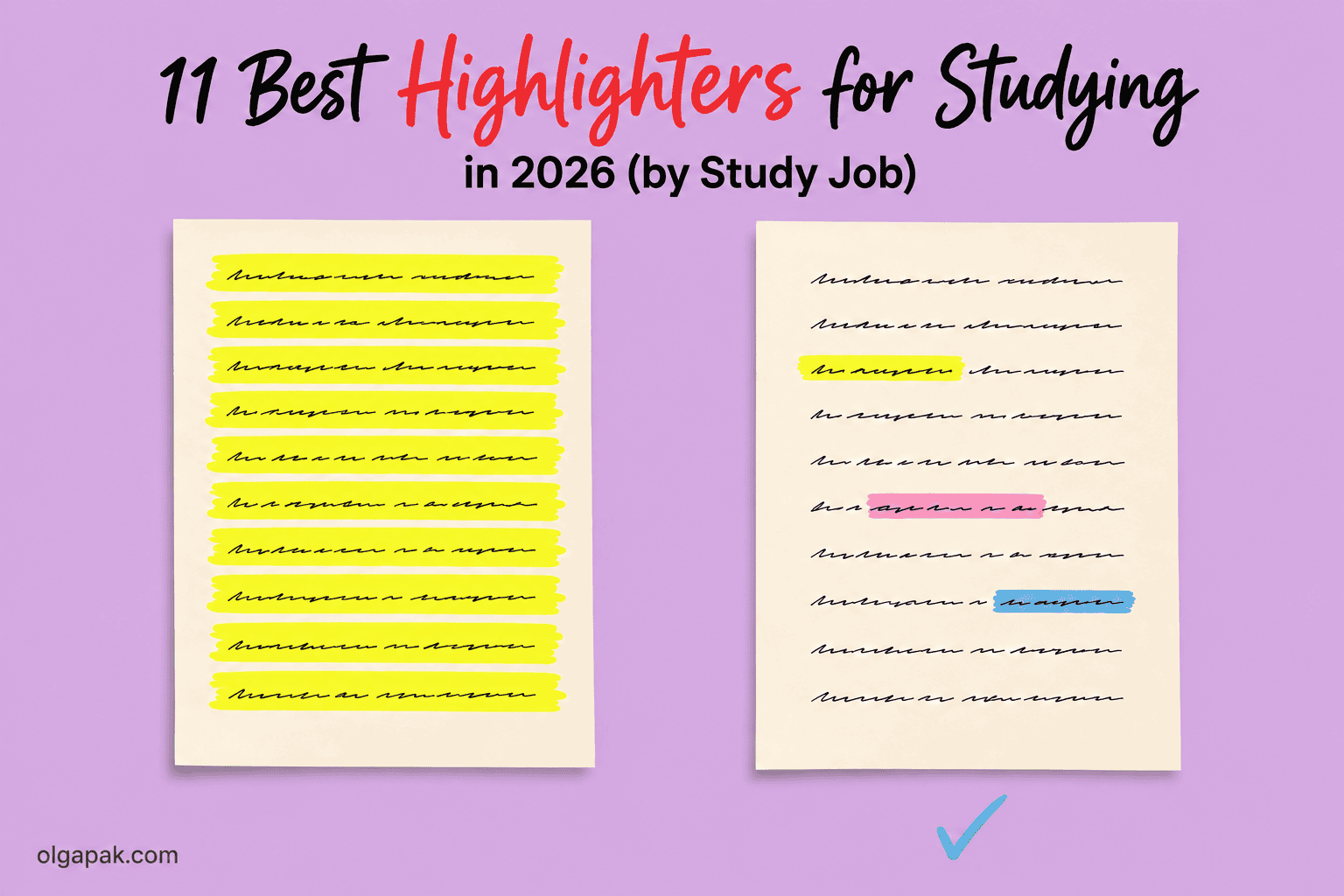
I once opened a textbook chapter I had “studied” the week before and found every single line glowing yellow, which is how I learned that the best highlighters for studying are only as good as the system you use them with. Ouch!
Between a Master’s degree done the long way (printed readings, a highlighter in each pocket) and a decade of hand-marked weekly plans, I have worn through more highlighter sets than I would like to admit, so these picks come from use, not from a catalogue.
How much you should highlight at all depends on whichever note-taking method you use, because a Cornell page and a mind map ask completely different things of a marker.
This guide covers whether highlighting helps at all (and the three-colour key that makes it work), how to choose a highlighter in sixty seconds, and 11 picks sorted by the job you actually need done: thin textbook pages, gel-ink notes, pastel readability, library books, pencil-case carry and a whole-semester budget pack.
Some links in this guide are affiliate links. As an Amazon Associate, I earn from qualifying purchases, at no extra cost to you.
What are the best highlighters for studying?
So which highlighter should you actually buy?
If you want one answer and no shopping, start here:
- Best overall for notes: Zebra Mildliner
- Best for textbooks: Stabilo Boss Original
- Best over gel ink: Zebra Mojini
- Best for thin paper: Staedtler Textsurfer Dry
- Best budget pack: Sharpie Pocket
Here is the whole shortlist. Only one pick is refillable, and only in its neon version.
| Highlighter | Best for | Tip | Neon or pastel | Refillable | Erasable | Price tier |
|---|---|---|---|---|---|---|
| Stabilo Boss Original | Heavy-duty textbook chapters | Chisel (2 + 5 mm) | Neon | Yes (neon line) | No | $$ |
| Staedtler Textsurfer Dry | Thin paper: Bibles, law texts | Wax pencil | Neon | n/a (sharpen it) | No | $$ |
| Zebra Mojini | Highlighting over gel and fountain-pen ink | Soft chisel | Neon | No | No | $$ |
| Zebra Mildliner | Colour-coding notes | Chisel + bullet | Pastel (fluorescent sets too) | No | No | $$ |
| Tombow MONO edge | Underlining and margin notes | Chisel (3.8 mm) + extra-fine bullet | Neon-leaning brights | No | No | $$ |
| Stabilo Boss Original Pastel | Pastel at textbook scale | Chisel (2 + 5 mm) | Pastel | No | No | $$ |
| Pilot FriXion Light | Library books, second thoughts | Chisel | Neon (Soft version is pastel) | No | Yes | $$ |
| Sharpie Clear View | Precise single-word marks | See-through chisel | Neon | No | No | $ |
| Stabilo Swing Cool | Pencil case and pocket | Chisel (1 + 4 mm) | Both | No | No | $ |
| Sharpie Pocket | Budget multipack | Chisel | Neon | No | No | $ |
| Pilot Kire-Na | Fast-drying premium pick | Dual tip | Both (10 shades) | No | No | $$$ |
Price tiers are bands, not prices: $ is the cheapest way to fill a pencil case, $$$ is an imported treat.
Does highlighting actually help you study?
A student on r/GetStudying asked recently whether they were over-highlighting, because they highlighted all the text and could not remember a single colour when they tried to recall it. The top reply (score 101) did not spare them: “What’s the point of highlighting if you highlight everything? Highly key WORDS not key SENTENCES.”
I have been that student. My glowing chapter from the intro was a whole page of “important”, which is another way of saying nothing was.
The research is on Reddit’s side here. A 2013 review of ten common study techniques rated highlighting a low-utility study technique on its own, while practice testing and spacing your study sessions out came out as the high-utility ones.
So should you stop highlighting?
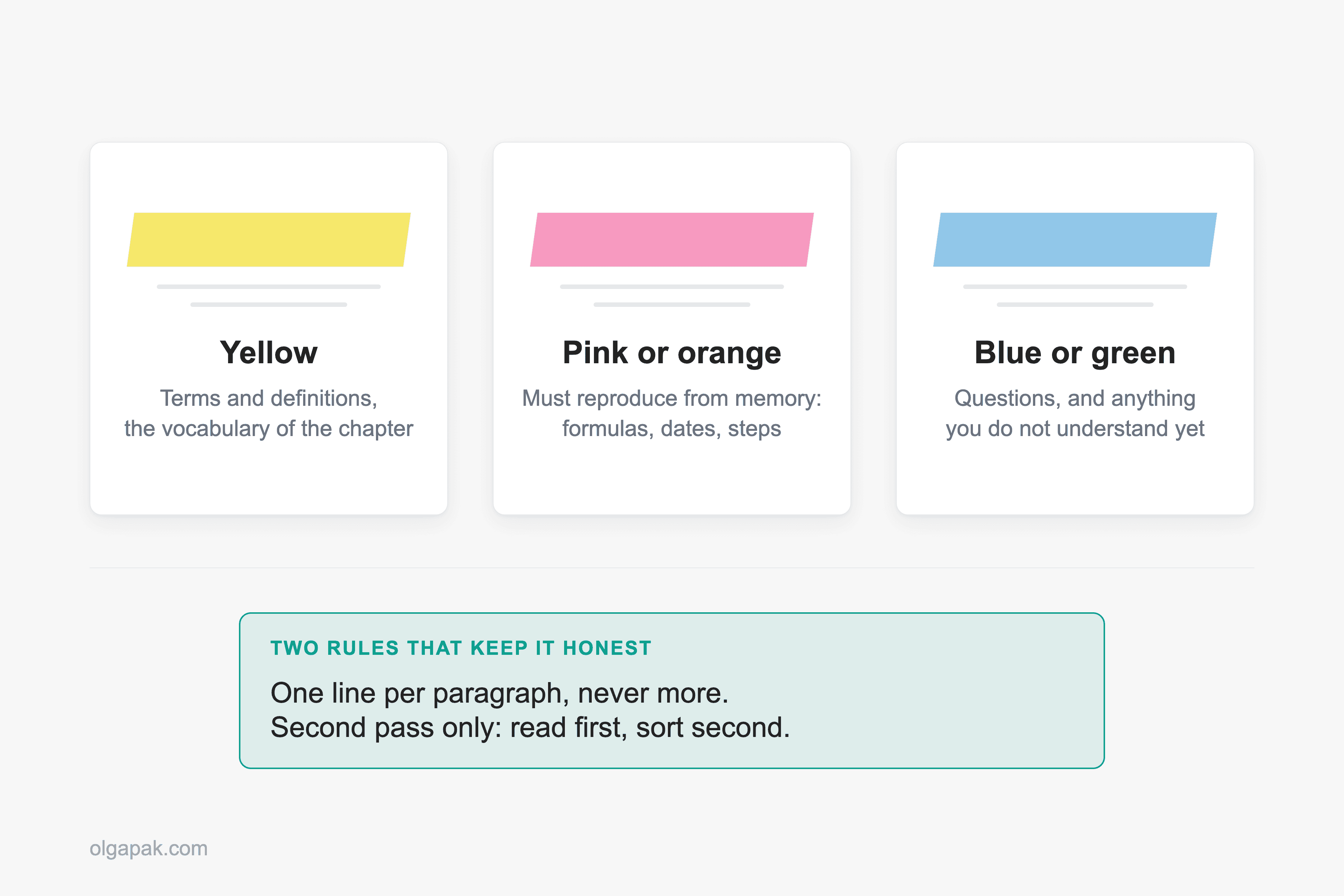
Nope! You stop highlighting on the first read, and you give each colour a job. This is the three-colour key I have used since my Master’s:
- Yellow: terms and definitions, the vocabulary of the chapter.
- Pink (or orange): things I must be able to reproduce from memory: formulas, dates, the steps of a process.
- Blue (or green): questions, and anything I do not understand yet.
Two rules keep it honest. Never more than one line per paragraph, and if a whole paragraph earns a colour, write a margin note instead. And second pass only: the first read is for understanding, the second is for sorting.
That sorting step is what feeds a real method. In Cornell notes, the blue questions become your cue column and the pink items become your recite list, so the highlighter is doing prep work for recall rather than standing in for it.
A vascular surgeon who mentors medical students put the other half well on X (@action_ap): use your favourite highlighters because comfort keeps you consistent, not because the colour does the remembering.
How to choose a highlighter for studying (a 60-second primer)
So what actually separates a good highlighter from a bad one?
Five things decide whether a highlighter suits your studying, and none of them is the brand on the barrel.
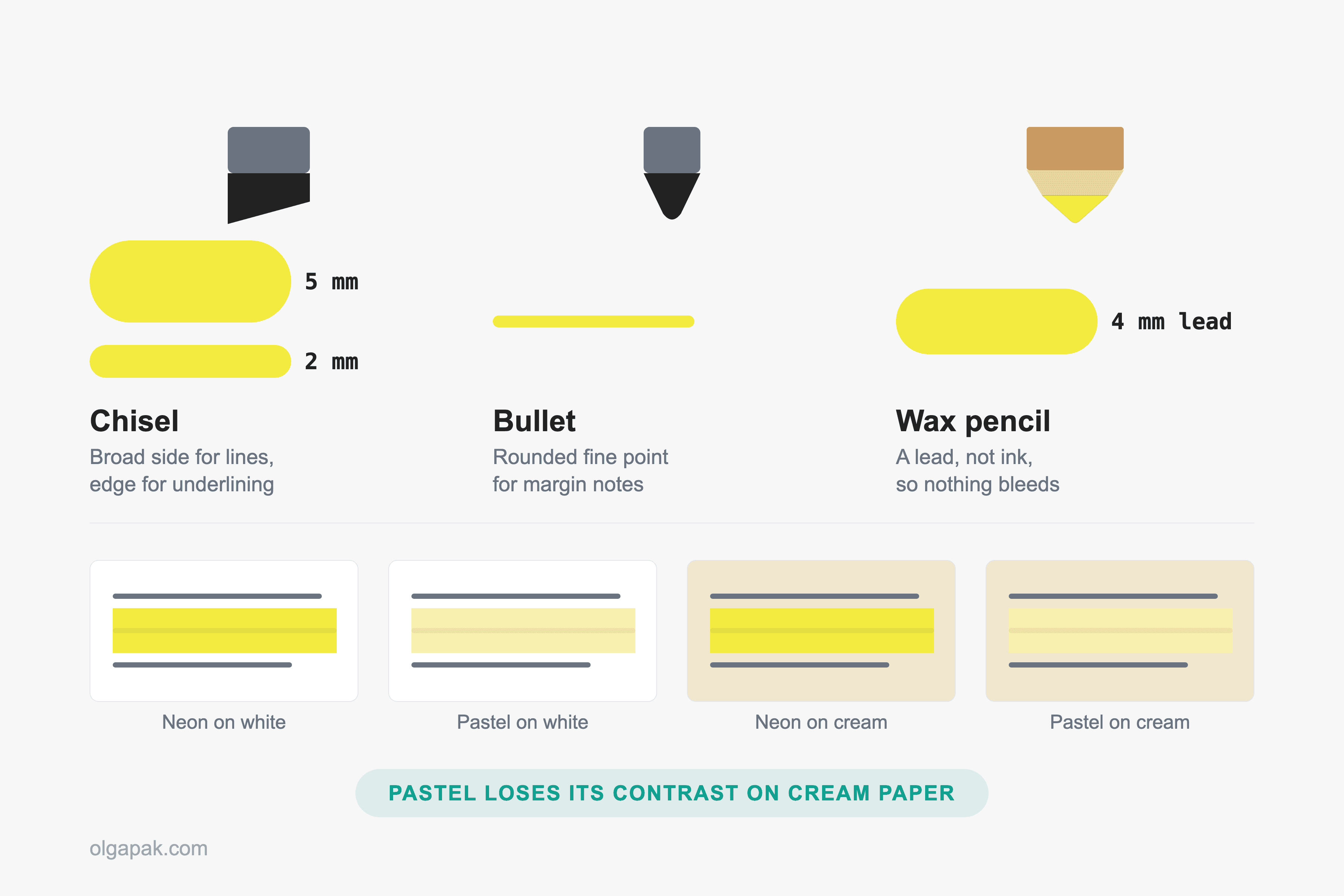
Three words first, because every review uses them: feathering is colour creeping out from the edges of a line, bleed-through is ink soaking through to the next page, and ghosting is seeing the mark through the page without it soaking through.
- Tip shape. A chisel tip is flat and angled: the broad side lays a wide line and the edge draws a thin one, 5 mm and 2 mm on a Stabilo Boss. A bullet tip is a rounded fine point for margin notes (the second end of a Mildliner), and a highlighter pencil is a wax lead with no ink at all.
- Neon or pastel. Neon wins for contrast on white textbook paper and for single-word marks. Pastel is easier on the eyes over hours of re-reading and gives a wider palette for a colour key, at the cost of contrast on cream paper.
- Ink. Highlighter ink is water-based, so it drags other water-based inks (gel, rollerball, fountain pen, inkjet print) even when they look dry. Oil-based ballpoint shrugs it off.
- Bleed-through. Usually the paper, not the pen. When someone blamed a Mildliner set for bleeding through on r/stationery, the top reply (score 490) was “your paper is very thin”. Change the paper before the pen: a notebook with 80 to 100 gsm paper (gsm is grams per square metre, the paper’s weight) fixes more bleed-through than a new highlighter does.
- Dry-out and refills. Every highlighter fades with heavy use or a lost cap; nobody in the r/stationery dry-out thread had found one that avoids it, and one commenter in that thread said reliable refills were the one thing they would pay a real premium for. Stabilo’s answer is the Boss Original, which the company says can be left with its cap off for up to 4 hours without drying out.
The 11 best highlighters for studying
So which one belongs in your bag?
Every pick gets a Best for line and a Watch out line, because none is perfect.
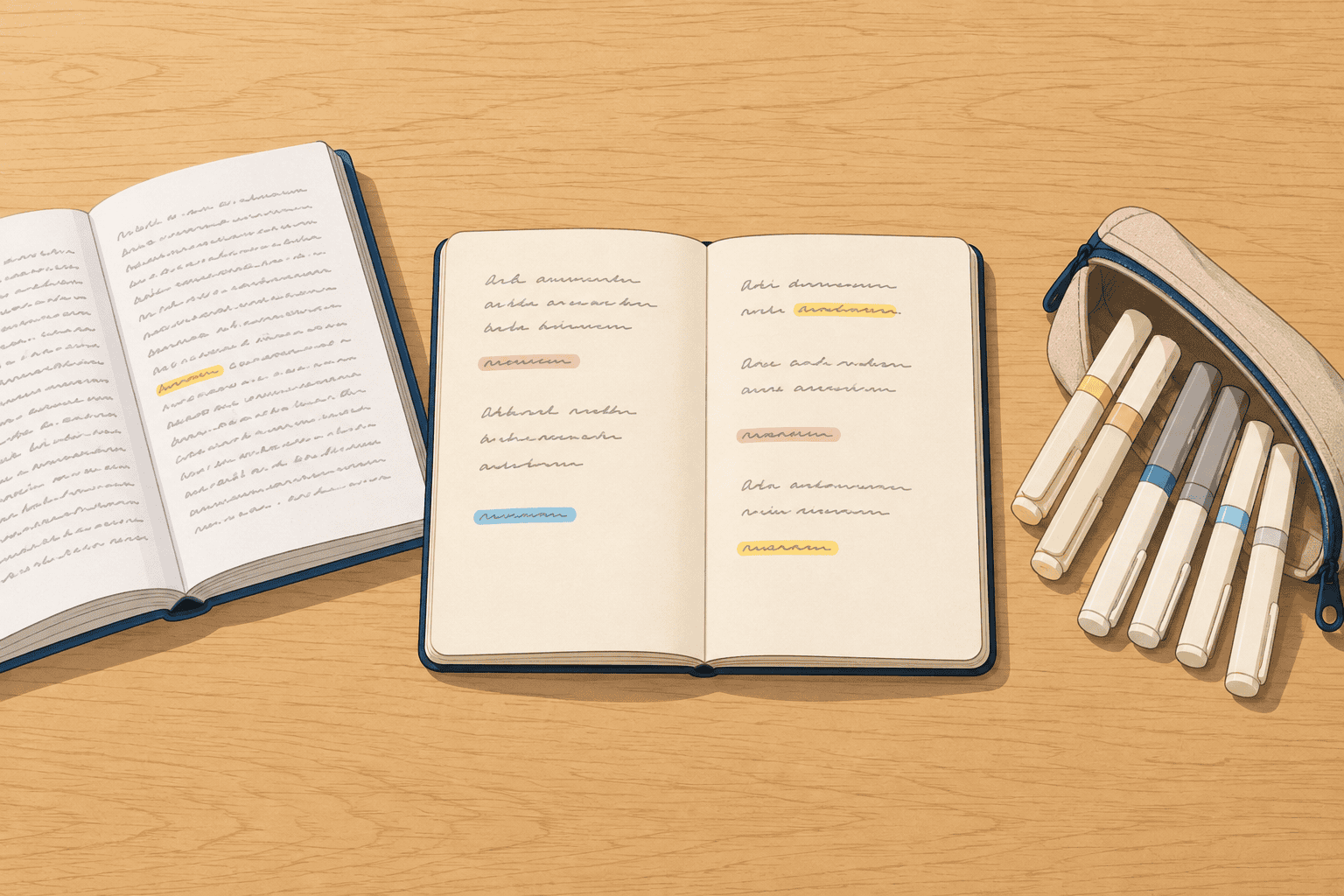
Stabilo Boss Original, best heavy-duty textbook highlighter
The Stabilo Boss Original is the fat highlighter you picture when someone says the word, around since 1971. The chisel gives you 5 mm for lines and 2 mm for underlining, the four-hour cap-off claim is this pen’s, and the neon body is refillable.
On r/stationery, the counter-pick to the Mildliner (score 37) was blunt: “Stabilo Boss are the best. Mildliners are cute and fun, but Stabilo Boss are where it’s at for heavy duty highlighting.”
Best for: a semester of textbook chapters and printed readings.
Watch out: neon shows through thin pages, and the fat body is not a pencil-case pen.
Staedtler Textsurfer Dry, best for thin paper (Bibles, law texts, cheap textbooks)
No ink. That is the entire trick. The Staedtler Textsurfer Dry is a wood-cased pencil with a neon wax lead, so nothing soaks through and nothing dries out in your bag. Staedtler’s own line is “no bleeding through thin paper, e.g. law texts, newspapers, bible passages”. Four neon colours, a jumbo triangular body, no Amazon US listing.
Best for: anything printed on thin paper, and any book whose paper you cannot change.
Watch out: neon only, a softer line than ink, and you will be sharpening it.
Zebra Mojini, best for highlighting over gel and fountain-pen ink
The Zebra Mojini is Zebra’s smudge-resistant highlighter, with an ink formula that binds with water-based ink such as gel, ballpoint, fountain, and inkjet to prevent smudging. The soft chisel flexes to stay on the page in a textbook gutter (the curve near the spine) and lays a line of about 3.5 to 4 mm. Five colours, in 5-packs and 12-packs.
A hands-on test on r/pens, though, found Zebra’s smudge-resistant highlighters still smeared some gel and fountain-pen inks, and the tester’s verdict was that they seemed “no better than regular good quality highlighters”.
Best for: people who write notes in gel pen and highlight them later.
Watch out: neon only, and it still smears some inks.
Zebra Mildliner, best for colour-coding notes (and the pastel favourite)
The Zebra Mildliner is double-ended, a chisel on one end and a bullet tip on the other, in what Zebra calls “a unique mild color that shows up softly on paper”. The ink is translucent and water-resistant, so it layers well, and packs run from 5 to 25 pens across six palettes: Cool, Warm, Friendly, Refresh, Gray and Fluorescent. Wirecutter counts around 40 shades in all.
It is the consensus pick in nearly every roundup I read. One r/stationery loyalist (score 91) has been “using the same set for 4+ years”.
Best for: the three-colour key on notes you will re-read for hours.
Watch out: it smears gel ink badly (Wirecutter names the Pentel EnerGel RTX, Uni-ball Signo RT1, Pilot G-2 and Zebra Sarasa), and the ink pools slightly at each end of a line.
Tombow MONO edge, best dual-tip for underlining and margin notes
The Tombow MONO edge puts a 3.8 mm chisel and an extra-fine bullet tip in one pen. A plastic sleeve keeps the chisel’s shape against a ruler, and Tombow claims its fast-drying ink doesn’t smear when highlighting over pencil or ink and “won’t bleed through most papers”. Six colours.
Best for: underlining and tiny margin notes with one pen.
Watch out: the palette leans neon, and six colours is a small range for a full pastel key.
Stabilo Boss Original Pastel, best pastel on a trusted body
The Stabilo Boss Original Pastel is the same 1971 body, the same chisel and the same four-hour cap-off claim as the neon Boss, in Stabilo’s 14 pastel shades. It exists for one reason: the wide Boss chisel in soft colours, for chapters where the slim Mildliner feels too small. It also placed in the top three of one large hobbyist pastel swatch test.
Best for: pastel readability at textbook scale.
Watch out: no refill for the pastel line, and pastel shows less on cream or recycled paper.
Pilot FriXion Light, best erasable highlighter (library books and second thoughts)
The Pilot FriXion Light has a 3mm chisel tip and uses heat-sensitive ink, so rubbing the built-in rubber tip over a line makes the colour disappear. There is a softer pastel version, the FriXion Light Soft.
Best for: borrowed books and library copies.
Watch out: Pilot’s own FAQ warns that leaving pages near heaters or in a car on a hot day can heat the paper enough to make FriXion ink invisible, so it is wrong for anything you must keep, and erased lines can ghost on some paper.
Sharpie Clear View, best for seeing the line you’re laying down
The Sharpie Clear View has a see-through window in its chisel tip, so you watch the words as you cover them. It is the natural pen for the “key WORDS not key SENTENCES” rule. Sharpie also markets its Smear Guard ink on this line.
Best for: precise, single-word highlighting.
Watch out: neon only, and the clear tip window scuffs with heavy use.
Stabilo Swing Cool, best pocket and pencil-case highlighter
The Stabilo Swing Cool is a flat, slim highlighter with a clip, a non-slip grip and a cap that posts. The chisel gives 4 mm for lines and 1 mm for underlining, with the same four-hour cap-off claim as the Boss. Eight fluorescent and 14 pastel shades.
Best for: the one highlighter that lives in your pencil case.
Watch out: the 4 mm chisel is narrower than the Boss, so big textbook lines take two passes.
Sharpie Pocket chisel-tip highlighters, best budget multipack for a whole semester
Sharpie Pocket chisel-tip highlighters are the budget classic: a chisel tip, a pocket clip that survives a bag, and multipacks big enough to lose three and not notice. One student on X (@jmmybears) put Sharpie first in their review-season kit: two jumbo ones lasted the whole season.
Best for: stocking a whole semester without thinking about it.
Watch out: neon show-through on thin pages, and no refills.
Pilot Kire-Na, best fast-drying premium pick
The Pilot Kire-Na is a dual-tip highlighter that won the Grand Prize at Japan’s Stationery Shop Award 2025, judged by stationery-store staff and run by the publisher Fusosha, per Pilot’s February 2025 announcement. Pilot aims these refinements at students:
- quick-drying ink, with the writing underneath resisting smudges
- a tip designed so straight lines come out straight
- less ink pooling at the end of a stroke, and less bleed-through
Ten colours, five bright and five soft, one of them a warm gray, no Amazon US listing.
Best for: left-handers and fast note-takers who smear everything.
Watch out: premium tier, imported (sold through Japanese-stationery retailers), and a small colour range.
How to highlight over gel pen ink without smearing
This is the question I get most from anyone who has read the pens roundup, and it starts with chemistry. Highlighter ink is water-based, so it drags water-based pen inks (gel, rollerball, fountain pen, inkjet print) even when the page looks bone dry, while oil-based ballpoint ink stays put.
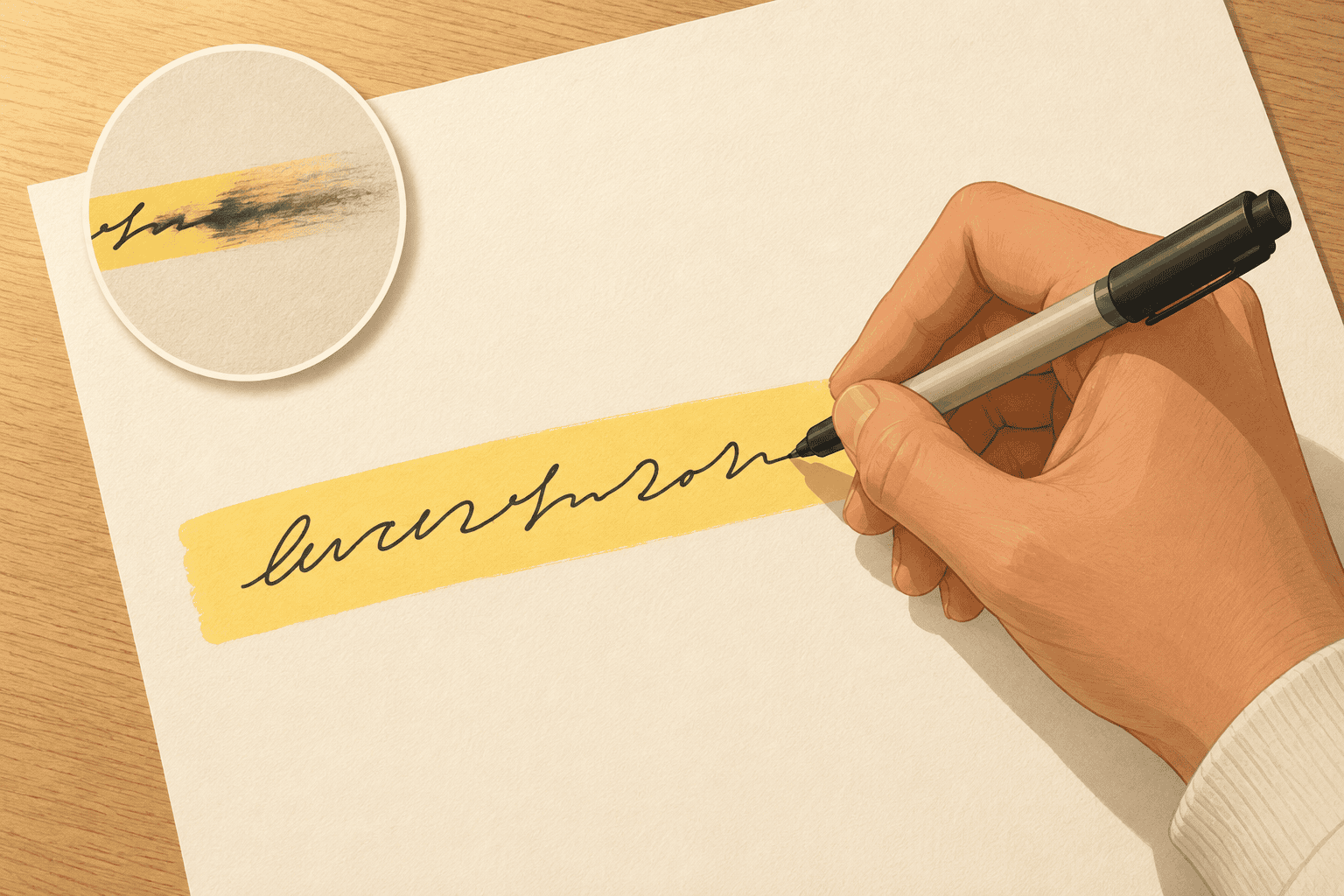
Wirecutter’s Mildliner review says it plainly: some ink, particularly gel ink, can smudge pretty badly while being highlighted. Its fix is just as plain: use a ballpoint.
Three fixes, in the order I would try them:
- Switch the pen. A ballpoint or a fast-drying hybrid ink is safe under any highlighter on this list, and the best pens for note-taking ranks the highlighter-safe ones.
- Highlight first, write second. The advice from the r/pens smudge test was to “highlight first, write on it second so no smearing”, and it works: a dried band of highlighter takes ink on top without complaint.
- If you must highlight over gel, reach for the Mojini, wait until the ink is properly dry, and use a light touch.
Highlighting on paper vs on an iPad
The detail that surprised me most in the research: someone had rebuilt the Stabilo Boss and Mildliner palettes as hex codes for GoodNotes, Notability and Noteshelf. The colour key travels to the screen even when the pen does not.
So should you just highlight on a screen?
Digital wins for PDF readings, searchable highlights and zero bleed-through. Paper wins when you want a page you can flip and a physical limit on how much you can mark, which is the whole point of the key above. If you are on the app side, taking notes on an iPad covers the setup.
Turn the highlights into something you can revise from
Once you mark a chapter with the three-colour key, the pink and blue passages are a revision sheet in waiting. Try my free AI tools to automate the mundane part: paste those passages into the Text Summarizer for a short sheet you can quiz yourself from, or run the paragraph you keep re-highlighting through the Text Simplifier when the problem is the sentence, not you.
The highlighter sorts. The remembering is still yours to do, and that, happily, is the part that never stops teaching you something.
FAQ
Are pastel or neon highlighters better for studying?
Neon is better for contrast on white textbook paper and for marking single words you want to jump out on a re-read. Pastel is better for notes you will re-read for hours and for a multi-colour key, because the softer shades are easier on the eyes and come in wider palettes. The trade-off is that pastel loses contrast on cream or recycled paper, so match the shade to the paper you actually use.
Why does my highlighter bleed through the page?
Usually because of the paper, not the pen. Thin loose-leaf and standard notebook paper cannot take highlighter on both sides, whatever the brand, which is the verdict the stationery community reached when someone blamed a set of Mildliners for bleeding. The fixes are heavier paper in the 80 to 100 gsm range, a dry highlighter pencil for books whose paper you cannot change, or simply highlighting one side of each sheet.
How do I highlight over gel pen without smearing?
Highlighter ink is water-based, so it drags water-based gel ink even when the page looks dry. Let the gel dry completely, press lightly, and where you can, highlight first and write second so the pen goes over the dried band rather than under it. Switching to a ballpoint removes the problem entirely, and the Zebra Mojini gives the best odds when you must highlight over gel, though it is not a guarantee.
Does highlighting actually help you study?
On its own, not much. A page where everything glows tells you nothing on the second read, and students who highlight everything tend to remember nothing in particular. Highlighting earns its place as a sorting step that feeds recall: mark a few key words on a second read, give each colour a fixed meaning, and turn the marked passages into questions you test yourself on.