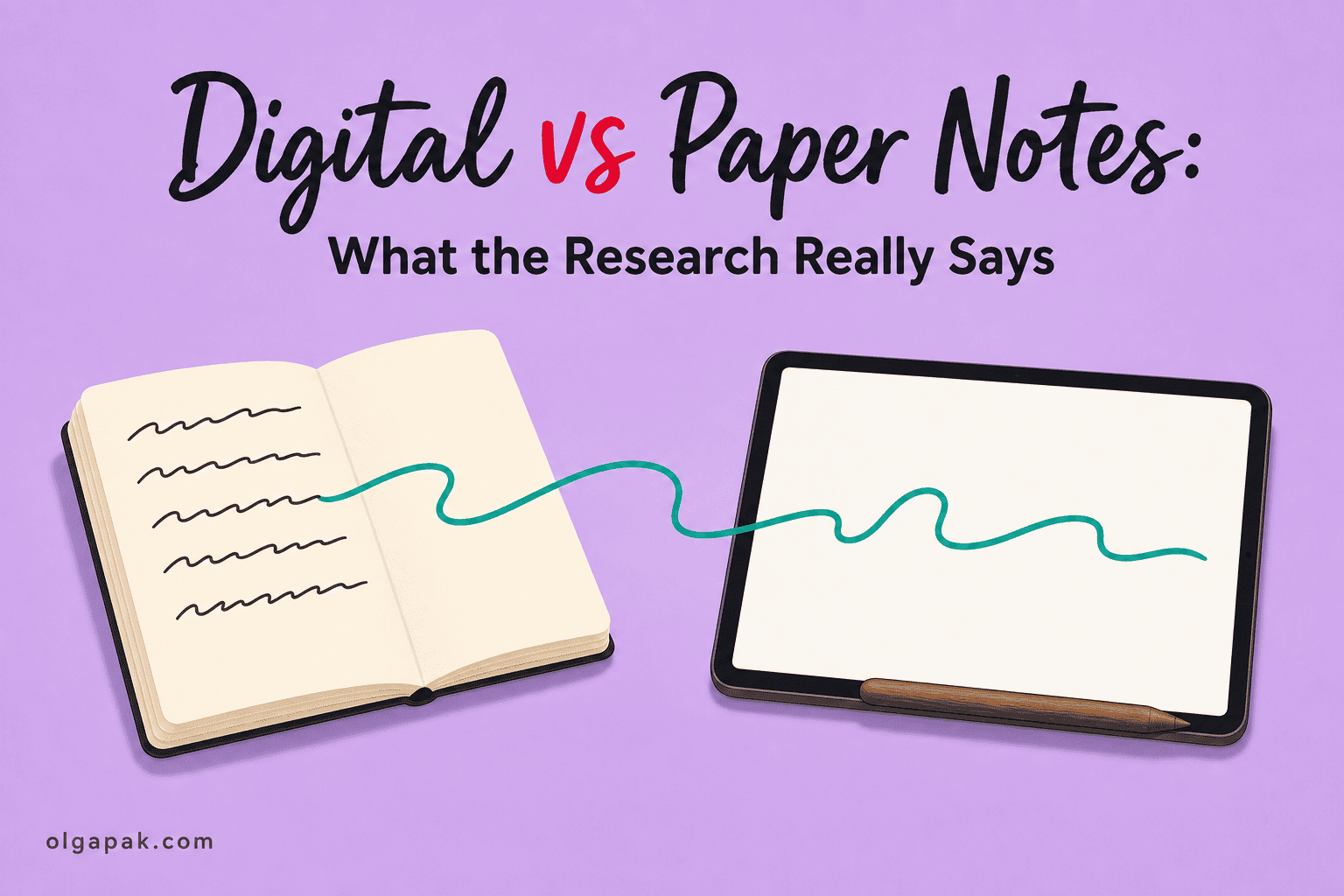
Digital vs Paper Notes: What the Research Really Says

Search “digital vs paper notes” and just about every result tells you the same thing with total confidence: writing by hand helps you remember more. Almost none of them tell you where that comes from, and several of the most confident pages don’t cite a single source anywhere on them.
When I went back for a Master’s after a decade in aviation PR, I had to relearn how to study from scratch, and I spent a full semester switching between a laptop, a notebook, and a tablet, convinced the next setup would be the one that made things stick. It wasn’t the setup. What I eventually worked out is a good deal less exciting than the internet’s version, and a lot more useful.
Part of what I got wrong was blaming the device when the real variable was the note-taking method you use, which shapes how much thinking happens on the page no matter what you’re holding.
This guide covers what the research actually found, the difference between handwriting and paper that almost everyone collapses, where each option genuinely wins, and a simple rule for picking one.
Digital vs paper notes: the four real options
Before the memory question, the framing needs fixing. Digital vs paper notes sounds like two choices, and it isn’t. It’s four, and most comparisons squash three of them into one bucket labeled “digital.”
The University of Wisconsin-Madison’s GUTS tutoring service is one of the few pages that splits this properly: typed, digitally handwritten, and paper, rather than screens on one team and paper on the other. Add the hybrid workflow that experienced note-takers actually use, and you get four real options.
| Option | How it works | Best for | Main advantage | Main trade-off |
|---|---|---|---|---|
| Paper notebook | Pen, page, nothing else | Lectures, new concepts, anything you’ll be tested on | Zero distractions, total layout freedom | You can’t search it, and you can lose it |
| Laptop typing | Keyboard into a notes app | Meetings, reference material, long documents | Fast, searchable, shareable, backed up | Easy to transcribe without thinking |
| Tablet + stylus | Handwriting on glass | Lectures where you also need PDFs and diagrams | Handwriting plus search and backup | The device is also a distraction machine |
| Hybrid | Handwrite first, digitize what matters | High-stakes study and work you’ll revisit | Encoding now, searchability later | Costs you one extra pass |
Notice what the table doesn’t answer yet: which one helps you remember more. Hold that thought, because the honest version of that answer has more caveats than the internet lets on.
What the research actually says (and what it doesn’t)
Almost every “handwriting wins” claim on this topic traces back to one paper: Mueller and Oppenheimer’s 2014 study in Psychological Science, published under the excellent title The Pen Is Mightier Than the Keyboard.
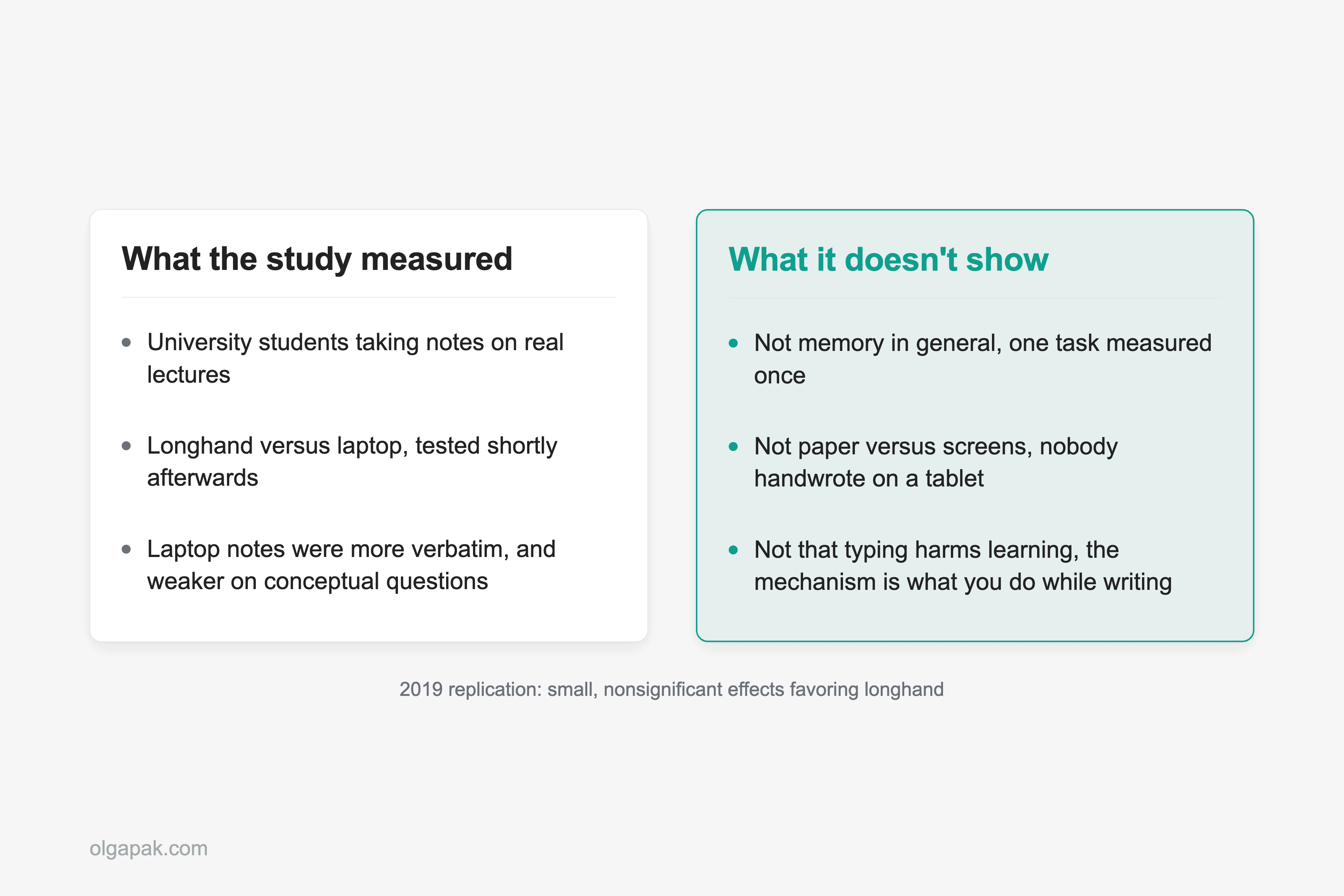
Here’s what it did. University students took notes on real lectures, some by longhand and some on laptops, then sat a test afterwards. The result: laptop note-takers recorded more of the lecture word for word and did worse on conceptual questions.
Two bits of jargon worth translating there. Word for word is what researchers call verbatim transcription, which just means writing down what you hear as it’s said instead of putting it in your own words. Conceptual questions are the explain-why kind, not the what-year-did-this-happen kind.
So why would the slower method win? Most people type considerably faster than they write by hand, and that speed turns out to be the trap. When your fingers can keep up with a lecturer, you never have to decide what matters. When they can’t, you’re forced to compress, and compressing is thinking.
That’s a genuinely interesting finding. What happened next to it is less interesting: it got flattened into “handwriting improves memory” and repeated everywhere, usually with no source attached.
The same University of Wisconsin GUTS page that lists high retention as a benefit of handwritten notes closes with a line most readers never scroll to: “please keep in mind not to assume all of the information described above is factual”. That is a university page disclaiming its own confident claim.
Readers have noticed too. On r/notebooks, a commenter pushed back on an article making exactly this argument: “calling this link a study is disingenuous, it’s a blog post with a lot of suppositions stated as fact.”
So here are three things the original study does not show:
- It isn’t a finding about memory in general. It measured one specific task: lecture notes, taken by students, tested shortly afterwards.
- It isn’t paper versus screens. Nobody in it was handwriting on a tablet. The comparison was longhand against a keyboard, not pulp against glass.
- It doesn’t mean typing makes you worse at learning. The mechanism it points to is what you do while you take notes, not the keyboard itself.
There’s one more thing almost nobody mentions. When other researchers ran the study again in 2019, some trends suggested longhand superiority, but performance did not consistently differ between any of the groups, including a group that took no notes at all. Their meta-analysis of the direct replications found small effects favoring longhand that weren’t statistically significant. That doesn’t overturn the original result, and it isn’t a verdict for typing either. It means the effect is smaller and shakier than five years of confident blog posts have implied.
Keep all of that in mind. It changes the entire shape of the decision you’re about to make.
It’s the handwriting, not the paper
If the reason handwriting helps is that it’s slower and forces you to put things in your own words, then the advantage travels with the motion. Not with the material.
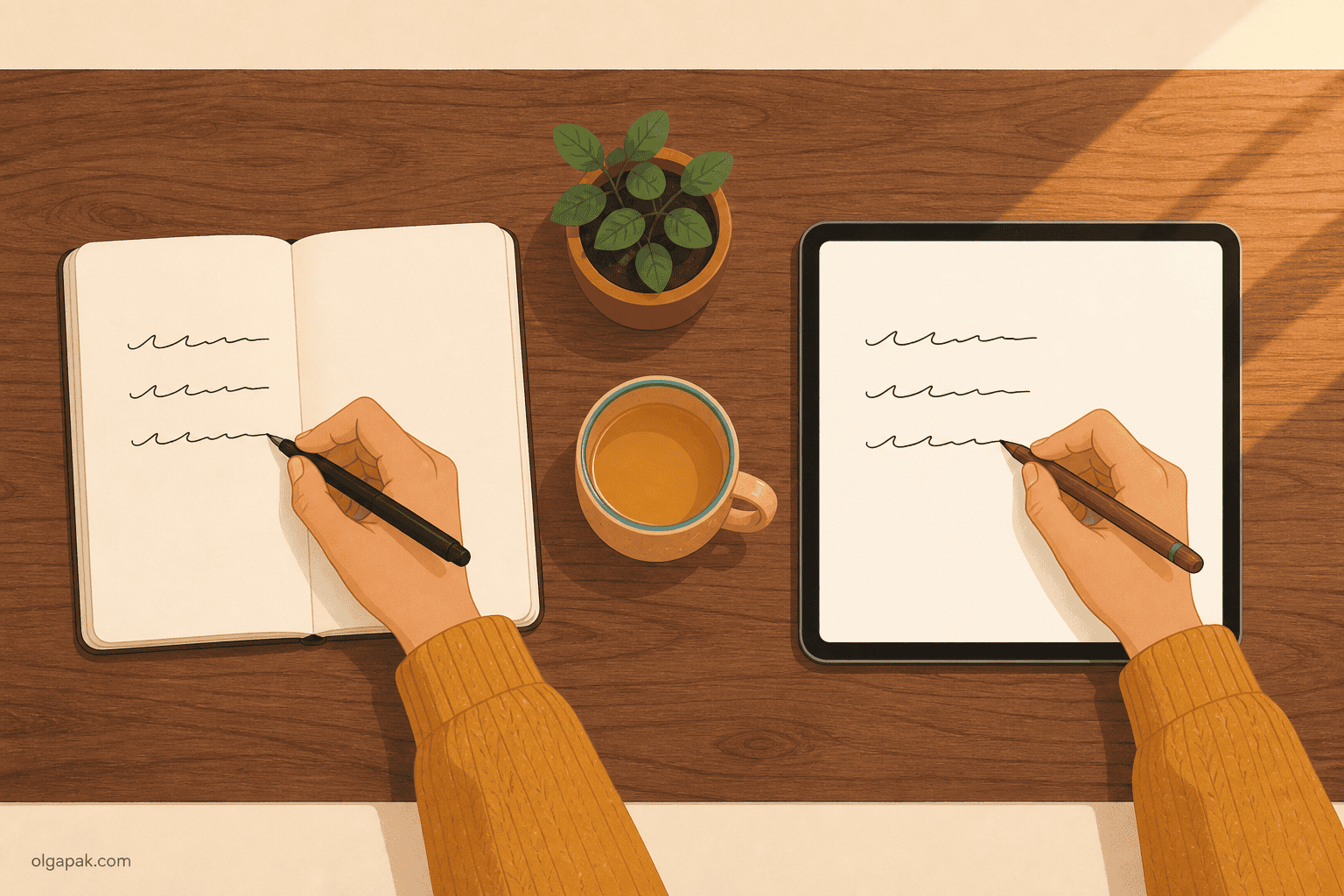
Readers reach this conclusion on their own all the time. One r/notebooks commenter put it more cleanly than most published comparisons manage: “Handwritten notes are, indeed, superior to typed notes – but it’s not exclusive to paper. Writing down notes with an iPad would be comparable.”
I want to be straight about the status of that claim, because this is exactly where the topic usually over-reaches. Nobody in the original study used a stylus, so this is an inference about the mechanism rather than something anyone measured. It’s a reasonable inference. It is not a result.
Still, it redraws the line, and the redrawn line is the practical part. It changes what you open tomorrow:
- Handwriting side: paper notebook, tablet with a stylus
- Typing side: laptop keyboard, phone thumb-typing, dictation into text
The Cornell method is the clearest illustration. It’s a page split into three zones, and it works identically ruled onto paper or drawn in a tablet app, because the thing doing the work is the summarizing you do in the cue column, not the surface underneath it. Move it to a keyboard and the layout survives, but the constraint that makes you compress does not.
This also settles a question I got stuck on for months, and I suspect you have too: is a tablet and stylus worth the money, or is it an expensive way to feel productive?
Framed as handwriting versus typing, the answer gets simpler. A tablet buys you the writing motion plus search and backup. It does not buy you a quieter room, and it costs you the one thing paper does for free.
So the real question isn’t “should I go digital.” It’s “am I writing, or am I transcribing?” You can transcribe on paper if you try hard enough, and you can genuinely think on a keyboard if you refuse to copy things down word for word. The surface is a nudge, not a verdict.
Where digital notes genuinely win
This is the part paper-nostalgia posts skip, and skipping it makes them useless. Digital notes win outright in situations where paper simply cannot compete.
So what can a screen do that a page can’t?
Search is the obvious one, and it’s not a small advantage. Finding one line from a lecture three months ago takes seconds on a screen and can take an entire evening in a stack of notebooks, assuming you kept the right notebook. Anyone who has ever hunted for a half-remembered definition the night before an exam knows exactly what that costs.
But the list is longer than search:
- Backup. A synced note survives a lost bag. A notebook doesn’t.
- Legibility. Your typed notes are readable in six months. Mine, handwritten at lecture speed, frequently are not.
- Sharing. Group projects, meeting actions, and anything a colleague needs tonight.
- Space. No running out of page, no carrying three notebooks around.
- Accessibility. Handwriting is not an option for everyone, and the University of Toronto Scarborough’s learning-strategies page names disability-related needs as a legitimate reason to choose typing. That is a real consideration, not a footnote.
Then there’s format-matching, which almost nobody mentions. If the thing you’re preparing for happens on a screen, practicing on paper is practicing the wrong task.
A commenter in r/PE_Exam, studying for a professional engineering license, made the point bluntly: “the exam is digital, uses the handbook as pdf and most importantly ctrl+F function. You can’t do that on paper!”
That’s not a preference. It’s a constraint, and constraints beat preferences every time.
There’s also a category of note-taking where speed is exactly what you want. In a meeting where you’re the one keeping the record, nobody is asking you to deeply encode anything. They’re asking for an accurate list of who agreed to what by when, and a keyboard is simply better at that job than your wrist is. And if speed is the whole point, there is a third option now: hand the capture to software entirely and keep the thinking for yourself, which is what AI note-taking is actually good for.
One more thing worth saying plainly: typing doesn’t cancel the learning benefit. It only costs you when it slides into transcription. Type in your own words, or spend a few minutes afterwards turning what you captured into a short summary, and you keep most of what handwriting would have given you.
Where paper genuinely wins
Paper’s advantages are quieter, and they’re mostly about what it refuses to do.
It’s slow. That’s the feature. A page can’t keep up with a lecturer, so it forces you to summarize instead of transcribe, which is the exact behavior the research points at. Friction is doing you a favor here, which is a genuinely strange sentence to write about a productivity topic.
A page also can’t show you a notification. If you take notes on a laptop or a tablet, you’re taking them on the same device that pings you every few minutes, and a review indexed by the National Library of Medicine notes that technology can support learning but creates challenges when it is not used intentionally. Intentionally is doing a lot of work in that sentence.
That semester of switching taught me the same thing without the citation. My typed lecture notes were fuller than my handwritten ones and I remembered less of what was in them, partly because a browser tab is always one keystroke away and no lecture is ever quite as gripping as whatever is inside it. The same trade-off shows up at work, where an open laptop is both the fastest way to capture and the reason you missed the last two minutes; I worked through that specific case in taking notes in meetings.
Paper also can’t autocomplete, sync-conflict, run out of battery, or need an app update ten minutes before a seminar. It just opens. That’s also why a paper planning system like a bullet journal survives a week that goes sideways: there’s nothing to re-sync, only a page to turn.
What does paper still do better?
- Review. One of the most upvoted comments in an r/PE_Exam thread about going fully digital was a flat one-liner: “paper notes are much easier to review.” Flipping through pages beats scrolling folders when you’re skimming for the bit you half-remember.
- Spatial memory. You often remember that a formula was bottom-left on a right-hand page. That hook doesn’t exist in an infinite scroll.
- Drawing freedom. Arrows, margins, boxes, a diagram that sprawls sideways. Mind mapping on paper takes no setup at all, while doing the same thing in an app means fighting a toolbar first.
And there’s an unscientific reason that still counts: a notebook you actually enjoy writing in gets opened more often than one you don’t. A system you use beats a better system you avoid.
The hybrid system most people actually land on
Ask real note-takers what they do and you rarely get a pure answer. You get some version of this, from r/productivity: “Both. I take notes on paper/eink, then put the important stuff into obsidian.”
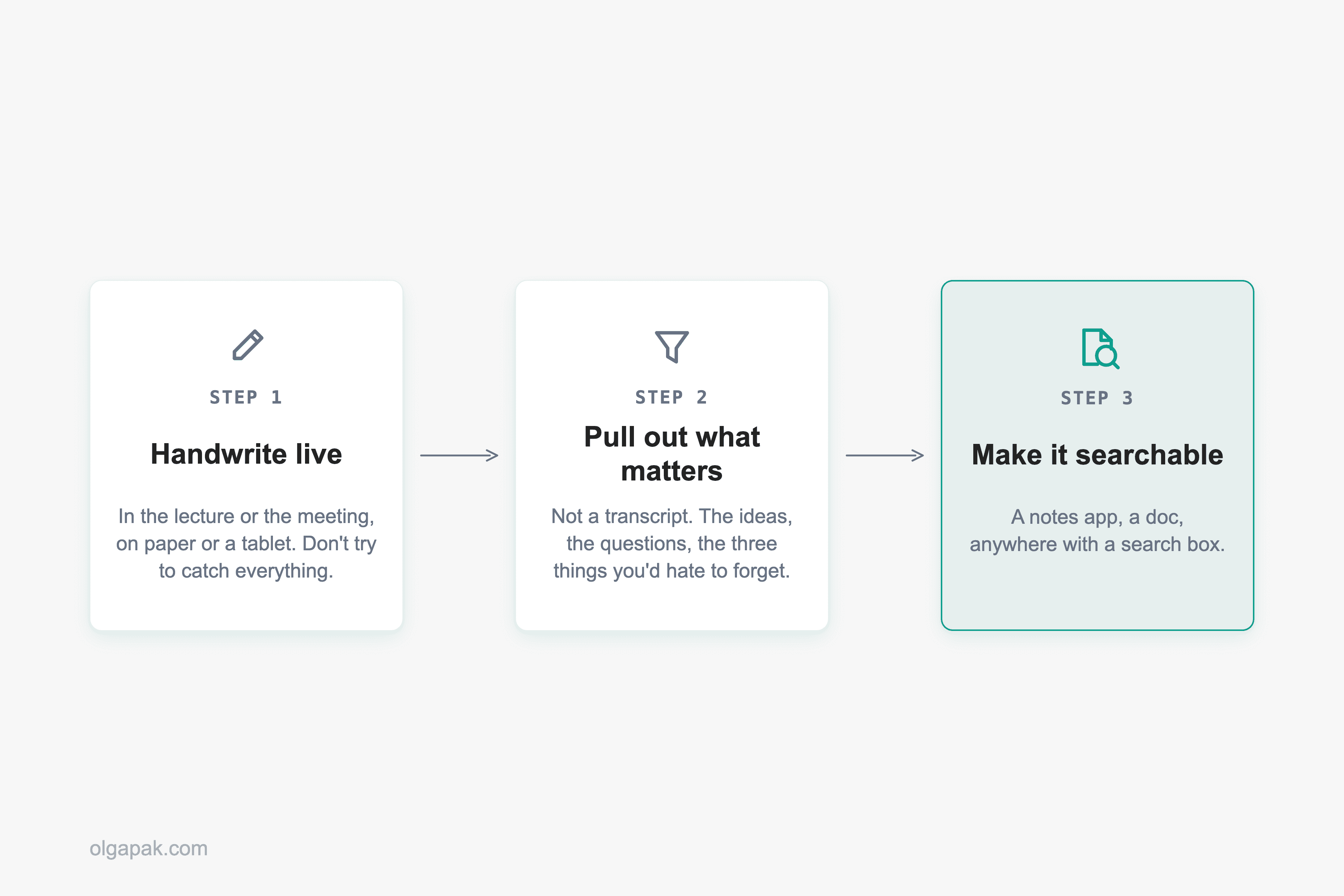
Handwrite first, digitize second. It sounds like extra work, and it is, but it resolves the whole argument: you get the thinking that happens while you write, plus a searchable copy you can find in eighteen months.
The workflow is smaller than it sounds:
- Handwrite live. In the lecture or the meeting, on paper or a tablet. Don’t try to catch everything.
- Afterwards, pull out only what’s worth keeping. Not a transcript. The ideas, the questions, the three things you’d be annoyed to forget.
- Put those in something searchable. A notes app, a doc, anywhere with a search box.
Here’s why it works better than either option alone, and it has nothing to do with the second copy. Step two is a review pass in disguise. You’re revisiting the material while deciding what matters, which is the single most useful study behavior there is, and you’re doing it without setting aside time to “revise.”
A warning about that second step, gently, because you might be the person I’m describing. Color-coding, matching fonts, and beautiful layouts feel like studying and mostly aren’t.
Someone in r/OntarioUniversities summed up the cure in one line: “screw aesthetic, I use red for headings, black for everything else.” Pretty notes are a lovely hobby. They are not a memory technique.
If the digitized version ends up long, that’s normal and it’s also the point at which most people stop revisiting it. Running it through my free Text Summarizer is the shortcut I use there: it condenses a wall of typed-up notes into something short enough that I’ll actually reread it before an exam or a meeting.
So which should you pick?
Almost every comparison on this topic ends on “it depends on you,” which is a non-answer wearing a humble face. Here’s a better rule, and it’s the one real note-takers describe using: pick by the stakes and the task, not by your personality.
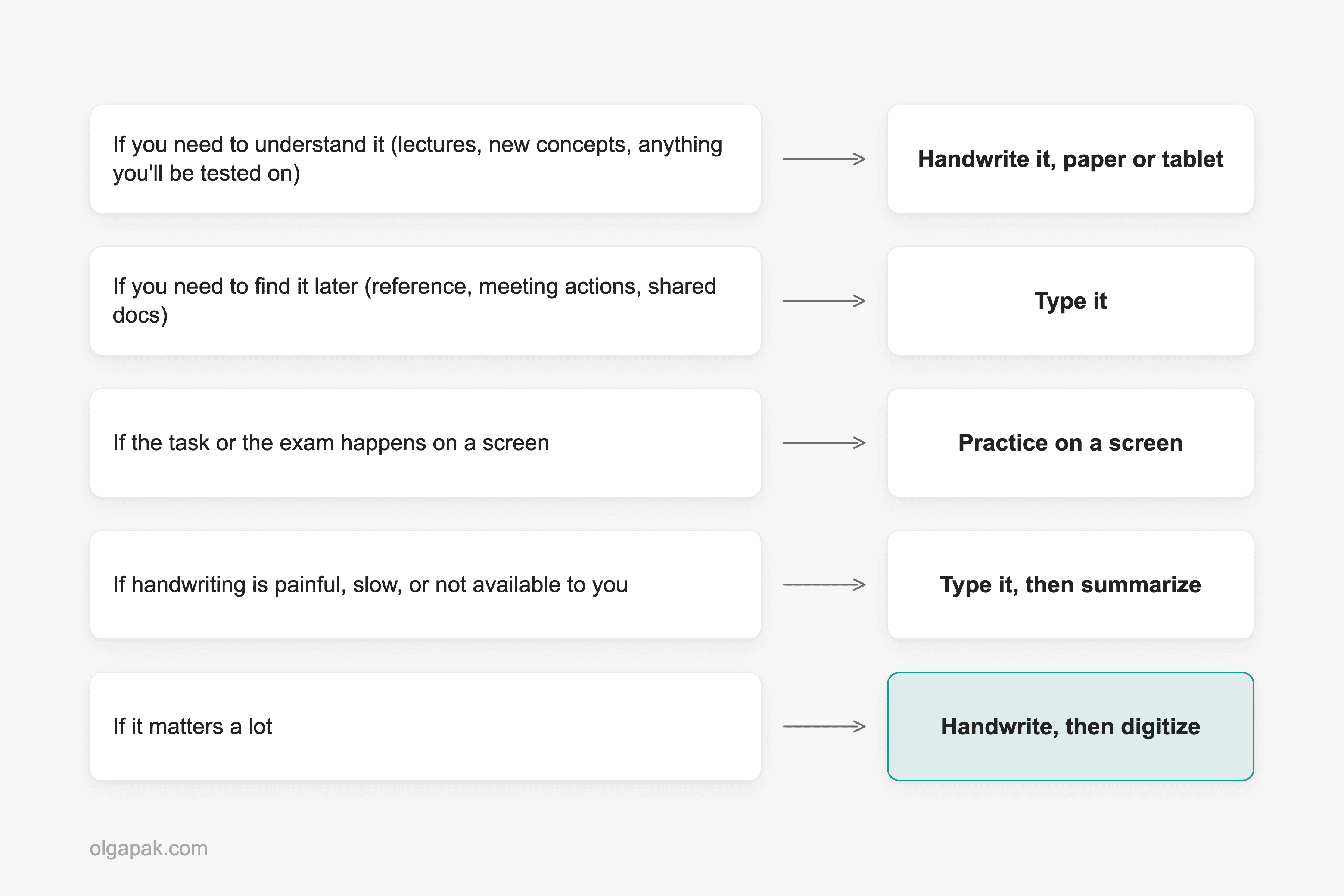
It’s the pattern that shows up over and over in threads where people compare their own systems. One r/productivity commenter’s version: “If it’s anything related to academia or work, paper notes always! … Other things, digital notes/lists are way more convenient.”
Here’s the rule in if-then form:
- If you need to understand it (lectures, a new concept, anything you’ll be tested on) → handwrite it, on paper or a tablet. Both sit on the handwriting side of the line.
- If you need to find it later (reference, meeting actions, shared docs, long documents) → type it. Search wins and it isn’t close.
- If the task or the exam happens on a screen → practice on a screen. Match the format you’ll be graded in.
- If handwriting is painful, slow, or not available to you → type it, and get the same benefit by summarizing in your own words instead of transcribing.
- If it matters a lot → handwrite it, then digitize the parts worth keeping.
Notice what’s missing from that list. Not one of those rules mentions paper as a material, or asks whether you’re “a paper person.” They point at the motion, the stakes, and the format of the task, because those are the parts that actually change the outcome.
That’s the position I’d defend: the motion matters more than the material, and the stakes decide the rest. If you’re choosing a medium for tomorrow, ask what the notes are for before you ask what they’ll be written on.
Your notebook isn’t holding you back. Your autopilot might be.
Automate the mundane part
Pick one medium for your next lecture or meeting using the stakes rule. Then check a week later whether you can still explain what it was about without reading your own notes. That’s the only experiment that settles this for you personally. One week, not one more comparison article.
The condensing step is the one that keeps falling off everyone’s list, mine included. If that’s where you get stuck, try my free AI tools to automate the mundane part so your energy goes into the thinking instead.
FAQ
Is it really better to write notes by hand?
For material you need to understand rather than just look up, the evidence points that way, and the reason is mechanical rather than magical: writing is slower than typing, so you’re forced to summarize instead of copying things down word for word. Worth scoping it honestly, though. The best-known study measured university students taking lecture notes and tested them shortly afterwards, so it’s a finding about that task, not a general law about human memory.
Do notes on an iPad count as handwriting?
For the mechanism that seems to matter, yes. You’re still forming letters by hand at handwriting speed, which means you still can’t transcribe a lecture word for word, which is the constraint doing the work. Being straight about it: the original study didn’t test styluses, so this is a reasonable inference about why handwriting helps rather than something anyone measured directly.
Is typing my notes bad?
No. Typing only becomes a problem when it turns into word-for-word transcription, because that’s the point where your brain stops choosing what matters and just relays it. Type in your own words, or spend ten minutes afterwards summarizing what you captured, and you get most of the benefit back while keeping search, backup, and legibility.
Should I rewrite my handwritten notes digitally?
Only the parts worth keeping, never the whole page. The value here is split roughly evenly between the searchable copy you end up with and the second pass itself, because deciding what deserves to be typed up is a review session you didn’t have to schedule. Rewriting everything verbatim turns a thinking task back into a copying task.
What should I use to study for an exam?
Handwrite while you’re learning the material, on paper or a tablet, since that’s the stage where compressing ideas into your own words pays off. Then match the exam’s own format when you practice: if the test is on paper, do practice problems on paper, and if it’s digital and searchable, practice in the environment you’ll actually sit in.