How to Take Notes in Meetings (Template + 5-Minute Habit)

You already know how to take notes in meetings: you type as fast as you can, you fill three pages, and a week later you open them and cannot work out what any of it meant. That is not a discipline problem, and you are not a slow typist. It is a structure problem, and the fix takes about five minutes.
I spent eight years in commercial aviation PR and international event management, where the notes from a client call were not admin. They were the thing the client was paying for. I still got this wrong for years before I changed what I was writing down.
If you have been working through note-taking methods hoping one of them survives contact with a real meeting, this is the meeting-shaped version of that hunt.
This guide covers the four things worth writing down, a template you can paste into your next meeting, the five-minute habit that does most of the work, and an honest answer on paper versus laptop versus letting an AI take the notes for you.
Why your meeting notes are not working
Most people walk into a meeting trying to produce minutes, the formal written record of what everyone said. That is a court reporter’s job. It is almost never the job you were actually handed.

The failure has a shape, and it shows up in the same words every time this comes up online. Someone on r/projectmanagement put it exactly: “By the time I’m able to record what was said from one topic, they’ve already moved onto the next topic and I’ve missed half of what was said.” Writing and listening compete for the same attention. You cannot run both at full speed.
So what should you be writing down instead?
Not the conversation. In a thread about how long write-ups honestly take, one project manager named it in a single line: “Are you minuting the conversation or the decision? Discovering that I should only be recording the decision was a huge lightbulb moment for me.”
There is also a blunter view worth answering, because you have probably suspected it yourself. “Ima let you in on a secret… nobody reads the notes anyways,” wrote a commenter in the same subreddit. Sometimes that is completely true! Which is why the template below is built for you first: your commitments, your deadlines, your memory of why a decision went the way it did. If someone else reads it, that is a bonus.
What to capture: the four-box meeting notes template
Four boxes. Write the headings down before anyone starts talking, and the hardest part of note-taking is already finished.
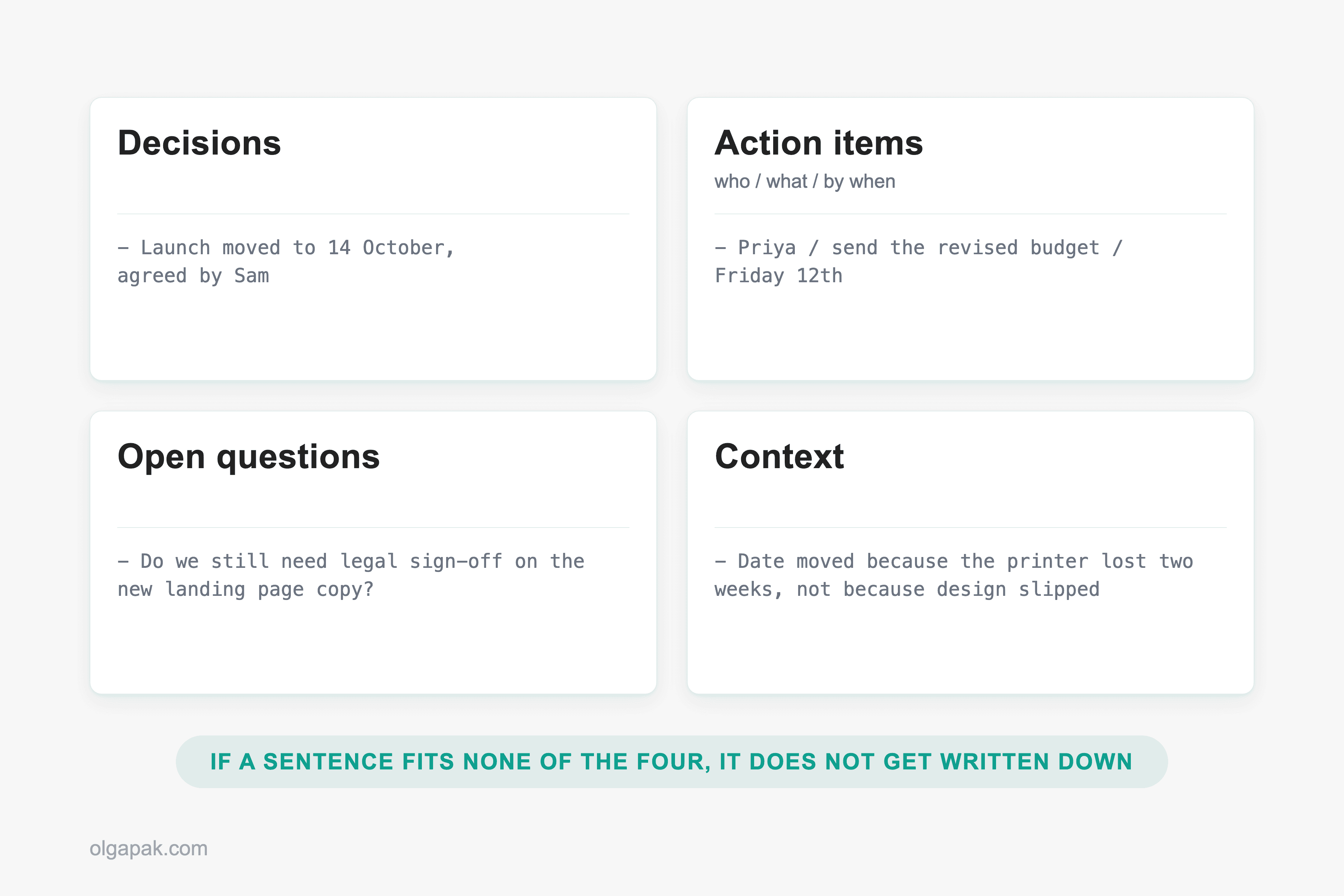
DECISIONS
- Launch moved to 14 October, agreed by Sam

ACTION ITEMS (who / what / by when)
- Priya / send the revised budget / Friday 12th

OPEN QUESTIONS
- Do we still need legal sign-off on the new landing page copy?

CONTEXT
- Date moved because the printer lost two weeks, not because design slipped
An action item is a task with a named owner and a date. Both parts, every time. “We should look at the budget” is not an action item, it is a feeling.
So why does a four-box page beat a blank one? Because the boxes make you decide where a sentence goes before you write it, and that decision is the filter. If a sentence fits none of the four, it does not get written down. Most of what is said in a meeting fits none of them, and that is the point rather than a flaw.
This is deliberately close to the Cornell note-taking method, which splits a page into a cue column, a notes column and a summary strip. If you have never seen the original, what the Cornell note-taking method actually is takes two minutes to read. The four boxes are the same idea with the meeting-room parts swapped in.
It is also roughly where people who do this all day tend to land. “I don’t try to capture and circulate ‘meeting notes,'” one project manager wrote in the same thread. “I capture actions, ownership and key decisions.”
Before the meeting: five minutes that make the notes easy
Most of the work of a good meeting note happens before the meeting starts. That is the least exciting sentence in this guide and probably the most useful one.
Five minutes, four moves:
- Skim the agenda. If there is not one, ask for it.
- Write out the four box headings, on paper or in a fresh doc.
- Pre-fill any action items carried over from last time, so you are ticking them off instead of rediscovering them.
- Write down the one question you personally need answered. If you leave without it, the meeting did not work for you.
No agenda, and nobody is going to send one? Then write the meeting’s purpose yourself, in one line, before you walk in. If you genuinely cannot write that line, that is worth raising beforehand rather than discovering halfway through.
For recurring status meetings where the same fields come up every week, the charting method fits better than four boxes: a grid with the same columns every time, so you are filling cells instead of writing prose.
Skip the prep and you pay for it afterwards. One project manager described their alternative in detail: record the meeting, get an AI summary, compare it against their own notes, go back to the recording to check details, simplify, correct, then send. Their honest total was roughly an hour of write-up for a one-hour meeting. That is one person’s account rather than an average, but it is what the sorting costs when you leave it all until later.
During the meeting: write less, catch more
The skill here is not speed, it is recognizing the shape of a sentence worth keeping. Decisions and commitments announce themselves: “let’s go with”, “I’ll take that”, “by Friday”, “we’re not doing that after all”.

Once you can hear those sentences coming, what do you actually put on the page?
Very little, and in a shorthand only you need to read:
- Fragments, not sentences. “Sam / print quote / Weds” is a complete note.
- Initials for people. You know who SB is.
- A star or a box in the margin for anything that becomes an action item, so you can find them all in one pass afterwards.
- When you are not sure a decision was made, ask out loud. “So we’re going with option B?” is participating, not interrupting, and it saves everyone a week.
Leave gaps. A blank spot in your notes costs you one line, and trying to fill it costs you the next three minutes of the conversation. Someone on X described that trade better than I can: “while I was busy writing down what you said 30 seconds ago, I was missing what you’re saying right now.”
If you write by hand you get a small bonus here. That research comes out of studying rather than meetings, more on which below, but the mechanic is the same: writing by hand pulls you into summarizing and paraphrasing as you go. You physically cannot keep up, so you condense instead. That is the behavior you wanted anyway.
One exception to all of this: brainstorms. When the point of the room is connections rather than decisions, a linear list actively fights the meeting, and mind mapping is the better structure to bring.
The five minutes after the meeting that do most of the work
Of everything in this guide on how to take notes in meetings, this is the habit I would keep if I had to drop the rest. Before the next thing starts, while the room is still in your head, do three things.
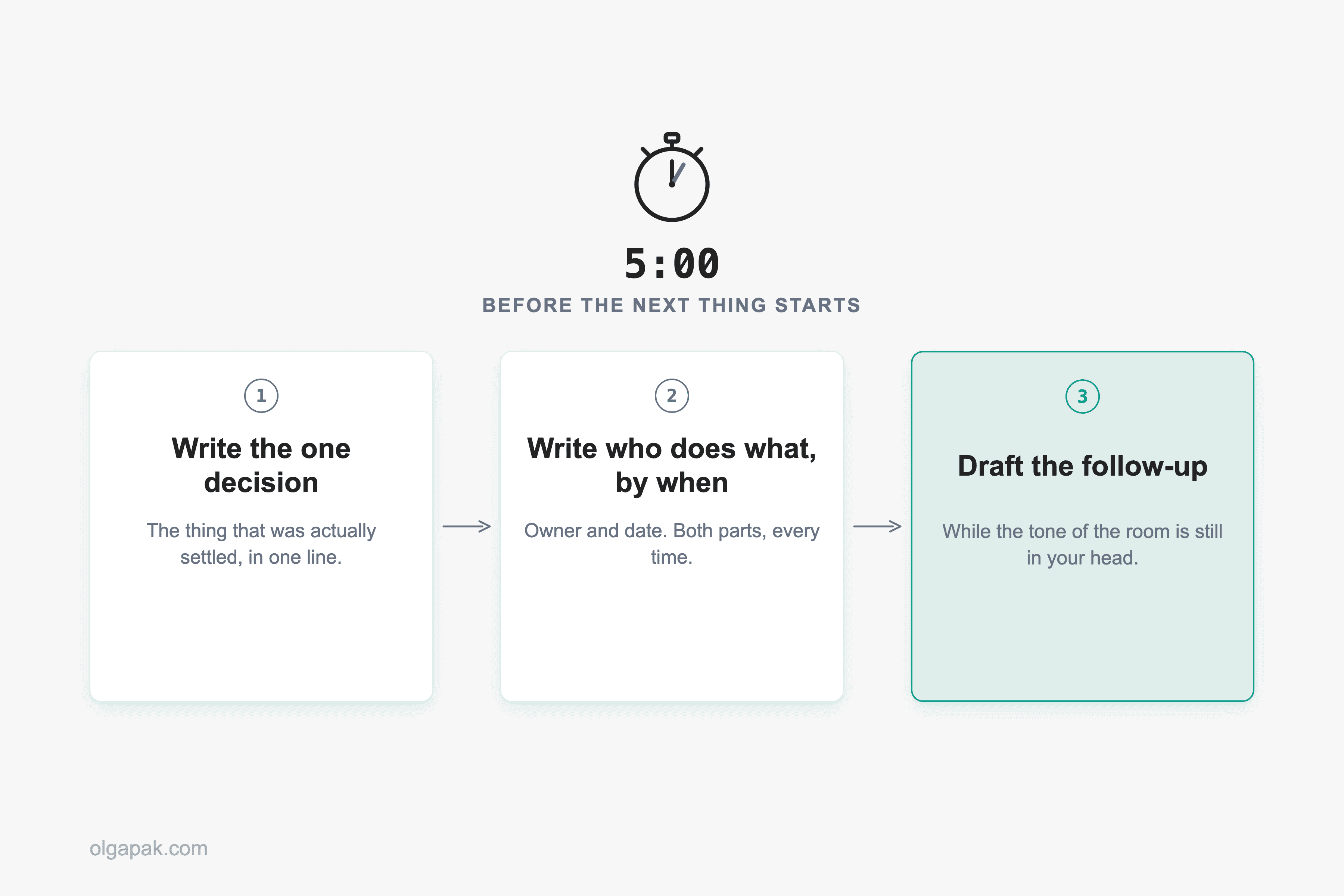
- Write down the one decision that was actually made.
- Write down who is doing what, by when.
- Draft the follow-up message while the conversation is still fresh.
That third step is the one everybody postpones, and it is the one that decays fastest. An hour later you will still remember the decision. You will not remember the tone.
One person on r/LifeProTips who switched to exactly this routine reported their post-meeting admin dropping from 45 minutes to 10. That is one person’s experience rather than a study, but the direction of it matches mine.
Why five minutes and not twenty? Because the job is capture, not tidying. Give it a hard stop: five minutes, timer running, then walk away. That is timeboxing, giving a task a fixed slot and stopping when the slot is up, and it works here precisely because tidying notes will happily expand to fill an entire afternoon if you let it.
Now the honest counterweight, because the most upvoted reply to that tip disagreed with it, and it had 973 upvotes when I checked in September 2026: “This is completely dependent on the job. In my job, most of the ‘real’ work happens during the meeting because if you don’t pay attention and engage in the conversation you’re going to have a bad time after.” Both positions are right, for different rooms. Status updates and information-sharing calls suit the capture-then-process approach. Negotiations, design reviews and anything where you have to think on your feet do not, and in those your notes should be four words and a star.
Paper, laptop, or an AI notetaker?
Two terms first, because they get used loosely. Transcription is a word-for-word text version of everything that was said. An AI notetaker is software that sits in on your call, transcribes it, and writes a summary afterwards.
| Where the notes live | Genuinely good at | What it costs you |
|---|---|---|
| Paper notebook | Forcing you to condense, no notifications, welcome in rooms where a laptop is not | Not searchable, not shareable without retyping |
| Laptop or phone | Speed, search, pasting straight into the follow-up message | A screen between you and the room, and every distraction you own is one tab away |
| AI notetaker | A searchable record of a call you can go back to, especially one-to-one video calls | Policy blocks, weak results in a room full of people, and it still does not decide what mattered |
So which one wins?
None of them, honestly. Most advice on how to take notes in meetings picks a side anyway, usually the side that sells something. The handwriting research is real, and it is also narrower than the internet suggests. Both the case that writing by hand is better for memory and learning and the finding that longhand notes beat laptop notes for conceptual retention come out of studying and lectures, where the job is remembering things later. A meeting’s job is usually different: produce a decision record other people can act on. So choose paper because it slows you down and has no inbox on it, not because a lecture-hall study said so.
AI notetakers deserve the same honesty. They are good at giving you a searchable record, and they are at their best on one-to-one video calls. Two real limits keep showing up, and both come from people using them rather than people selling them. The first is policy: “Many companies specifically prohibit recording meetings or using transcribing AI tools. And they often disable the tools,” as one commenter put it, and enthusiasm does not get you around an IT block. The second is the in-person meeting with several people in a room. “Why has nobody solved for in-person meeting note-taking?” someone asked on X, then answered himself across the replies: phone microphones do not handle group meetings well.
Worth naming the noise, too. Most of what you will read about meeting notes right now is a vendor selling a notetaker, which is exactly why this is not a tool roundup. Even a flawless transcript leaves the real work undone, because someone still has to decide what mattered. The longer version of this trade-off lives in my guide to digital versus paper notes.
When you are the one running the meeting
Different rules apply, and the main one is this: if you are leading the discussion, you should not be the person writing it down. Facilitating and note-taking pull on the same attention, so doing both means doing both badly.
Ask someone at the start, and rotate who that someone is. Then do the thing that makes their job easy: at the end of each agenda item, say the decision out loud. “So, we’re going with option B, and Priya sends the revised numbers by Friday. Everyone happy?” Ten seconds, and a conversation becomes a line.
The best version of this I have read came from someone describing a project manager who stopped after each section and put the key notes and actions on screen in front of the whole room. By the time the meeting ended, the notes were written and everyone had already agreed to them. No write-up. Nothing to chase.
If you are always the one taking notes
Here is the part most guides leave out. Taking good notes early in a career genuinely opens doors, and the job also lands on the same people over and over until it quietly becomes their role.
One commenter said it plainly: “I’ve heard that if you’re a minority, a young person, or a woman, then don’t take notes. Because then you’ll always be just the note taker, and nobody will actually listen to anything you have to contribute.” That is worth taking seriously rather than waving away with a line about attitude.
So what do you do if that is already your situation?
Two practical moves, rather than a lecture:
- Rotate the role. If nobody else proposes it, you propose it. “Shall we take turns on notes?” is not a hard sentence to say.
- If it keeps being you anyway, put your name on the decisions and the follow-through rather than on the typing. Send the summary yourself, chase the action items yourself, be the person who knows what was agreed and why. That is a different job from scribe.
Hand off the part you keep skipping
The step almost everyone drops is the follow-up message, because a blank draft at 4pm after your fourth meeting of the day is genuinely unappealing. That is the mundane part, and it is exactly the part worth handing off.
Try my free AI tools to automate the mundane: the Email Generator turns your three lines of action items into a first draft you can edit in a minute, and the Text Summarizer cuts a long transcript or a wall of raw notes down to something you will actually reread. Keep your attention for the meeting itself.
FAQ
How do you take notes in a meeting without missing what is being said?
Stop trying to capture sentences. Set up your four boxes before the meeting starts so that during it you are sorting rather than transcribing, and accept that most of what gets said should never be written down. Listen for decisions and commitments, write fragments, and leave gaps where you need to.
What should meeting notes actually include?
Four things: the decisions that were made, the action items with a named owner and a date for each, the open questions that were not settled and need carrying to next time, and one or two lines of context explaining why a decision went the way it did. Everything else is optional.
Is it better to take meeting notes by hand or on a laptop?
It depends what the notes are for. Handwriting is linked to better memory and comprehension, though that research comes from students and lectures rather than meetings, and it forces you to condense because you cannot keep up. A laptop is faster, searchable and easier to share into a follow-up message. A laptop is also a distraction machine sitting open in front of you, so weigh that honestly against the convenience.
Should I use an AI notetaker for meetings?
They are useful for one-to-one video calls and for keeping a searchable record you can go back to. They are weak on in-person meetings with several people in the room, and plenty of employers block recording and transcription outright as policy. They also do not remove the step that matters most, which is deciding what was important and turning it into action items.
How long should writing up meeting notes take?
About five minutes, if you captured decisions rather than conversation. If your write-up regularly takes longer than the meeting did, that is a signal to change what you write down during the meeting, not to write faster afterwards.