Digital Detox Plan: 7 Days to Reset Your Screen Time

You put the phone in a drawer on Sunday night, feel briefly heroic about it, and by Tuesday you’re checking it at traffic lights again. That isn’t a willpower failure. It’s the reason a digital detox plan beats another promise to yourself: a plan has steps, and a promise only has good intentions.
I work on a screen all day and build my own AI tools, so this is not a post telling you to quit screens. It’s what actually helped when I needed my attention back, tested rather than theorized.
If your particular problem is the scroll that starts with one notification and ends somewhere near the bottom of a feed, the trigger-level fixes live in my guide on how to stop doomscrolling. This post is the structured week you run them inside.
This guide covers the baseline to take before day 1, the seven daily steps, what to do when you slip, and the rules that keep it going after day 7.
What a digital detox plan actually is (and why cold turkey backfires)
A digital detox plan is a short, structured reduction in screen use with a defined start, a defined end, and one change at a time. That last part is the whole trick. It is not deleting every app on a Sunday night and hoping the feeling holds. It is also not the same thing as a dopamine detox, which is about the easy-reward habits underneath, some of which are not screens at all.
Am I overreacting about my own phone? Probably not, and neither are you. A review of 109 studies covering 97,748 people found about 37.1% of people worldwide show problematic smartphone use. That’s a description of how common this is. It isn’t a diagnosis, and it isn’t a verdict on your character.
Here’s the failure mode most detox advice walks you straight into:
- Sunday night: delete Instagram, TikTok, and the news app
- Monday: white-knuckle it, feel great
- Tuesday: reinstall one app “just to check something”
- Wednesday: back to normal, plus a fresh belief that you failed
You didn’t fail. The plan was badly built. Tanya Goodin, who founded Time To Log Off and wrote a book about switching off, put it plainly in The Guardian: “going cold turkey is daunting, so the week eases you in gently”. Her week ramps too, which is a decent sign the shape is right rather than just different.
One honest note before we start. As of December 2024 there was still no formal medical subject heading for “digital detox” on PubMed, the main database of medical research. This is a useful idea with real research around it, not a clinical procedure.
Before day 1: get your baseline number
Before you change anything, get a number. Day 8 means nothing without a day 0 to compare it against, and the real figure is almost never the one you would have guessed.
It takes about two minutes:
- On iPhone, check your Screen Time on iPhone in Settings and note your daily average.
- On Android, check Digital Wellbeing on Android for the same thing.
- Write down two figures: your daily average, and your pickups (how many separate times you pick the phone up).
- Screenshot the top three apps on that list. You’ll want them on day 2.
For scale: the broadcaster who ran The Guardian’s week-long detox experiment started at 4 hours 6 minutes a day and 57 pickups. If yours is higher, that’s information, not a scandal.
Then write one sentence, on paper, about what you want the extra time to feel like. Calmer. Better rested. Or one specific thing finally finished. That sentence does more work than the screen-time figure does, and the last section of this post is where it pays off.
The 7-day digital detox plan
Seven changes, one a day, each one leaning on the one before it. Every day’s setup takes under ten minutes, and every day has a smaller version for when your week is already too full.
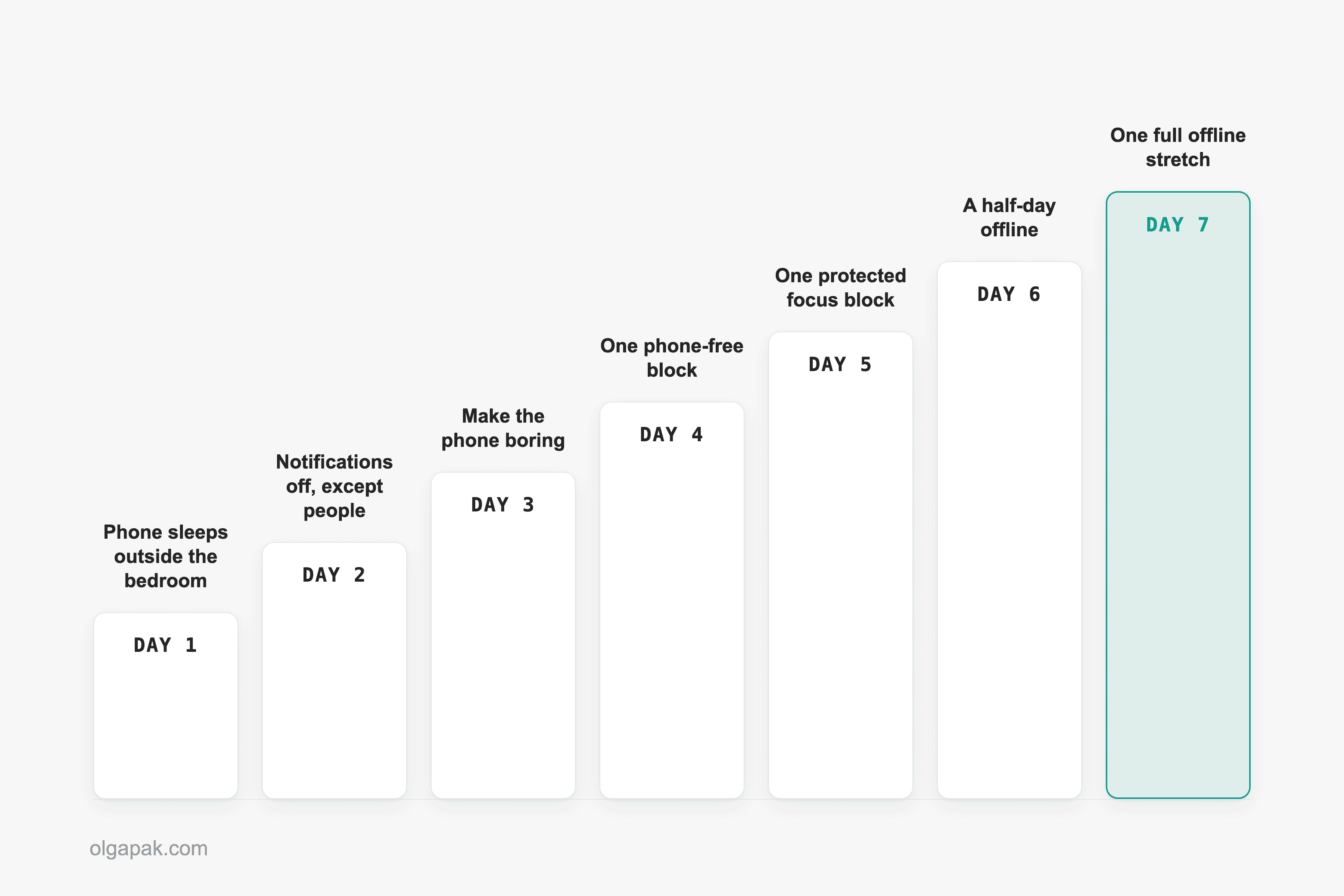
About expectations: that same Guardian participant finished her week at 3 hours a day and 17 pickups, down from 4 hours 6 minutes and 57. Better, not transformed. That’s the honest shape of a week like this.
Day 1: The phone sleeps outside the bedroom
Tonight, the charger moves. Hallway, kitchen, anywhere that isn’t within arm’s reach of your bed.
Why start here? It fixes the two worst windows of the day, the stretch before sleep and the first minutes after waking, without touching your working hours at all. You can be completely functional at work tomorrow and still have done day 1.
You’ll need an actual alarm clock, or the phone on the far side of the room. That’s the smaller version: still in the bedroom, just too far to reach without standing up. It sounds trivial. Standing up is exactly the friction you’re buying.
Day 2: Turn off every notification that isn’t a person
Keep the ones from actual humans: calls, messages, the family group chat. Turn off everything an app sends to win your attention back. Delivery nudges, streaks, “someone you may know,” news alerts, all of it.
Why now? Day 1 changed where the phone sleeps, and day 2 changes how often it interrupts you while you’re awake. It’s also the change that keeps paying you back long after the week ends.
The smaller version: open yesterday’s screen-time list, take the top three apps, and silence only those. Three is enough to notice the quiet.
Day 3: Make the phone boring on purpose
Three settings, ten minutes:
- Switch the screen to grayscale.
- Strip your first home screen down to tools (maps, camera, notes) and move every feed app off it.
- Open whatever’s left by searching for it, instead of tapping a familiar spot.
Now the warning, because this is the day people spend money instead of changing behavior. Buying a “boring” phone is not a plan. One commenter in r/iPhoneSE who bought a smaller phone specifically as a detox device reported that the detox effect lasted only while the smaller size still felt novel, and that they were soon back to short videos and games, exactly as before.
A capable phone stays capable. What changes the outcome is the configuration and the habit.
Smaller version: schedule grayscale for evenings only.
Day 4: One phone-free block, with something waiting in it
Pick one block today and leave the phone behind: a meal, a walk, the commute home. Then decide in advance what fills it, because an empty block gets filled by the phone by default.

This is the day that swaps rather than subtracts, which is why it holds up better than willpower does. If nothing comes to mind, I keep a long list of things to do instead of being on your phone for exactly this moment.
Smaller version: 20 minutes, phone in another room.
Day 5: One protected focus block
Airplane mode or Do Not Disturb, one block of real work or study, with a start time and an end time you decide before you begin.
The end time matters as much as the start. I picked up timeboxing, giving a task a fixed slot and stopping when it’s up, while juggling a Master’s with a side project, mostly because work kept expanding to fill whatever time I handed it. If the idea is new, here’s what timeboxing actually is in more detail.
Why day 5 and not day 1? By now the phone is quieter and duller, so a protected block is something you can keep rather than a fight you have to win.
Smaller version: 25 minutes.
Day 6: A half-day offline
Half a day with the phone off, or parked in a drawer. Choose the half-day where it costs you least, which for most people is a weekend morning.
One thing to say clearly: if someone depends on you being reachable, stay reachable. Caregiving is real and on-call shifts are real, and a plan that ignores them isn’t a plan. Park the phone, keep calls on, let everything else wait.
Smaller version: two hours.
Day 7: The full offline stretch, then look at the number
One continuous offline stretch. An evening through the next morning is the realistic version for most people, and it’s long enough to feel like something rather than just a gap.
Then open Screen Time or Digital Wellbeing and compare both figures with the ones you wrote down before day 1. Put the new pair next to the old pair, and add one line on what actually changed: sleep, mood, the thing you finished.
That number isn’t a finish line. It’s the starting point for whatever you decide to keep.
What to do when you slip (because you will)
You will slip. Probably in the evening, probably without noticing until you’re already deep in a feed.

A lost evening is data about a trigger, not evidence you’re weak. The recovery rule has three parts:
- Name the cue out loud. What happened right before you picked it up? Boredom, a hard task, hunger, an argument.
- Resume that same day’s step. Don’t restart the week from day 1.
- Never “make up” a missed day by doubling the next one. That’s all-or-nothing thinking wearing a different hat.
Does it get easier? Yes, and more slowly than you’d like. One detoxer in r/digitalminimalism described it taking about two weeks before the cravings genuinely dropped off, which is longer than this plan runs. Day 7 isn’t the point where it stops being hard. It’s the point where you have a structure to keep going with.
And if the phone has to stay in your hand for work or caregiving, subtraction isn’t your answer. Change what it’s for instead: I’ve collected productive things to do on your phone instead of scrolling for exactly that situation.
Day 8 and beyond: the rules that keep it
The week is the easy part. Day 8 is where most detoxes quietly come undone, because no one designed them to survive the plan ending. If you want the slower version of the same job, the one built to outlast the reset week, I’ve written separately about how to reduce your screen time for good.

Three rules, all deliberately small:
- Keep the single change that cost the least and gave the most. For most people that’s day 1, the phone sleeping somewhere else. Keep only that, and you keep most of the benefit.
- Pick one recurring offline slot. Just one. A commenter in r/nosurf described the version that has actually lasted in their house: no-phone Sundays with their partner.
- Re-check your baseline monthly, not daily. Watching the number every day turns the number itself into another feed.
Simple is doing real work in that list. In the same r/nosurf thread, a much more elaborate self-designed work cycle drew an immediate and fair reply: that it doesn’t fit a normal job. The systems people keep are the ones that fit in a sentence.
And the extreme version? One person in r/selfimprovement who spent three months without a smartphone at all ended it by reintroducing one “with strict boundaries and mindful usage.” Even the hardest version of this lands on a boundary, not a monastery.
The last piece is where the reclaimed time actually goes. If it goes nowhere in particular, it goes back to the phone, which is why I’d rather you spent ten minutes planning your week than another hour on settings. If the week after the reset feels emptier than you expected, that’s the gap to fill on purpose, and there are screen-free hobbies to fill the gap with an honest note on what each costs.
Does a digital detox actually work? An honest answer
So does any of this hold up? Partly, and less dramatically than the genre suggests.
An NIH scoping review of digital detox interventions landed somewhere in the middle:
- Detoxes may help with depression and problematic internet use.
- The benefit looks largest for people who start with more severe symptoms.
- Effects on life satisfaction and overall wellbeing remain variable.
That’s a genuine finding. It’s also a modest one.
The evidence base is thin, and I’d rather tell you that than oversell it. That review covered 14 eligible studies, and an earlier review rated only about 30% of studies in this area as high quality. A small 2020 study of 68 university students who had taken social media breaks did find that they reported better mood, better sleep, and less anxiety, which is encouraging, and is still 68 students describing their own experience afterwards.
Then there’s the objection I think is the strongest one anybody makes. A detox does not manufacture ambition. A commenter in r/digitalminimalism put it better than any abstract I read: a detox won’t magically make you productive, it just removes an easy escape.
That’s exactly right, and it’s why you wrote that sentence before day 1. The week hands you the hours back. What they feel like is still yours to decide.
Start tonight, not Monday
You don’t have to wait for a fresh week. Move the charger out of the bedroom tonight and day 1 is already done, which happens to be the change most people end up keeping anyway.
One more thing, because some of your screen time is just work that has to happen and no amount of grayscale fixes that. Try my free AI tools to automate the mundane: the Text Summarizer condenses a long article or report into something you can read in a minute, so a screen you had to be in front of anyway gives you a piece of your evening back.
FAQ
How long should a digital detox be?
A week is enough to reset the structure and move the number, which is why this plan runs seven days. Be honest with yourself about the rest, though: people who have done longer detoxes describe cravings fading over roughly two weeks, not seven days, which is what the day 8 rules are for.
Do I have to give up my phone completely?
No, and the version that demands it is the version that collapses by Wednesday. This plan reduces and re-times your phone use rather than banning it, and it bends where it has to. If work or caregiving means you must stay reachable, you keep calls on and change what you use the phone for instead.
What if I slip in the middle of the week?
Resume that same day’s step and carry on. Don’t restart the week, and don’t try to make up for it by doubling the next day. A slip costs you nothing as long as you treat it as information about a trigger rather than proof that you failed.
Does a digital detox actually improve focus or productivity?
The evidence is genuinely mixed, and the honest answer is that a detox removes an easy escape rather than creating motivation. Research on detox interventions points to some benefit for depression and problematic internet use, while effects on broader wellbeing vary. What you do with the reclaimed hours is still your call.
Will buying a simpler phone fix this?
Usually not on its own. People who buy a smaller or plainer device specifically to detox often find the novelty wears off and the old habits come back. The configuration and the routine around the phone are what change the outcome, not the hardware.