Pomodoro Technique: How It Works and When to Break It

The Pomodoro Technique was invented by a student with a tomato-shaped kitchen timer, and he only landed on 25 minutes after trying 10-minute bursts (too short) and hour-long stretches with no break (too long). Everything you’ve read about the magic of 25 minutes rests on one person’s trial and error in the late 1980s.
I came to timed work the boring way. After pivoting out of a decade in aviation PR and going back for a Master’s, my to-do list stopped fitting inside the day, and the only thing that genuinely moved the needle was giving work a fixed slot instead of an open-ended evening.
That habit already has a name, and giving a task a fixed slot on the calendar is the same instinct scaled up to whole afternoons rather than 25 minutes at a time.
This guide covers what the technique actually is, why timed chunks work, how to run your first one today, what the research does and doesn’t show, the moments the 25/5 rule stops working, whether it suits ADHD, and the timers worth owning.
Some links in this guide are affiliate links. As an Amazon Associate, I earn from qualifying purchases, at no extra cost to you.
What the Pomodoro Technique actually is
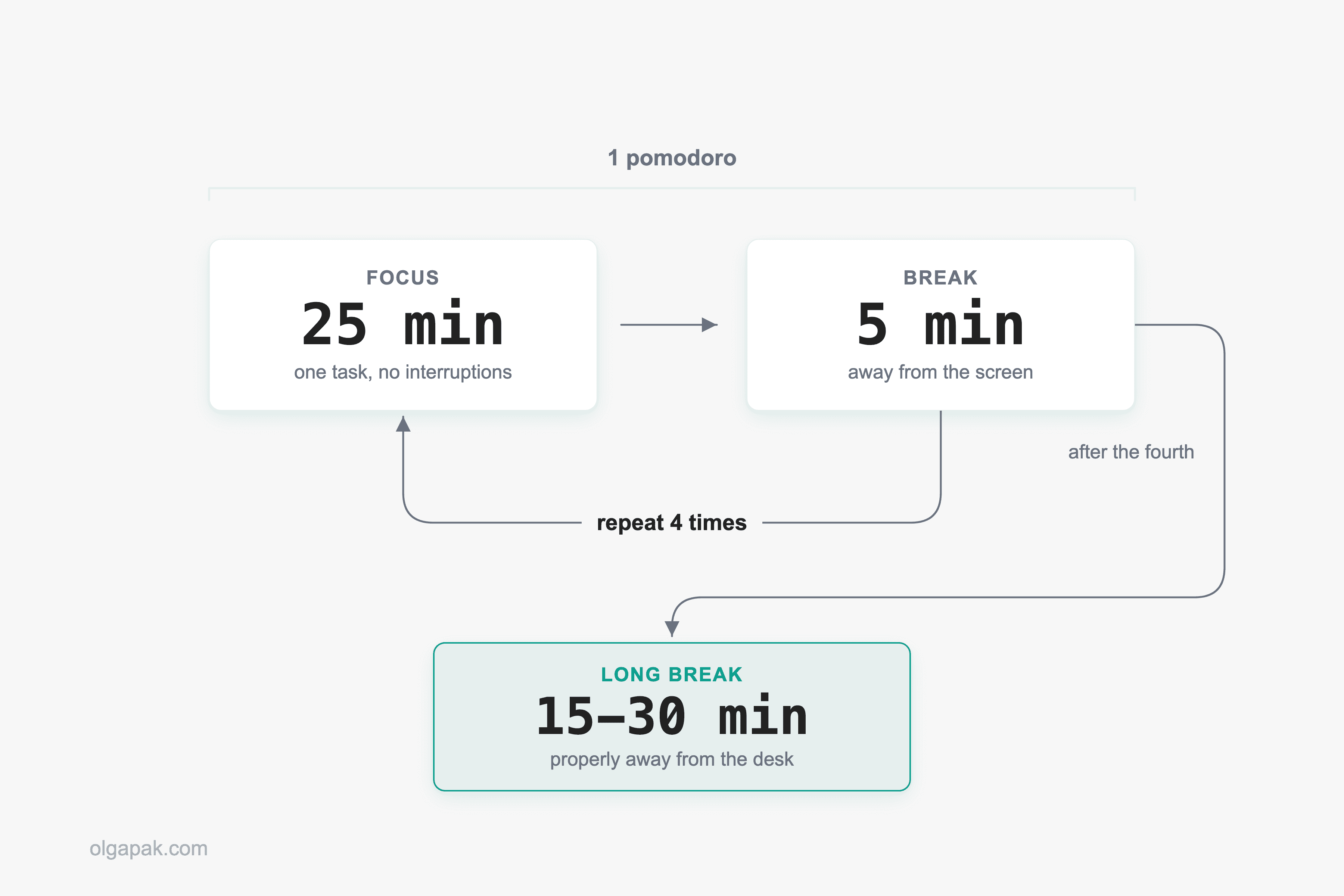
One pomodoro is a single unit of work: 25 minutes on one task, then a 5-minute break. After four of them you take a longer break of 15 to 30 minutes, and then you start the cycle again. That’s the entire mechanic.
The name is less mysterious than it sounds. Pomodoro is simply Italian for tomato, and Francesco Cirillo called it that after the tomato-shaped kitchen timer he used to time his study sessions as a university student. It is the least intimidating origin story in all of productivity.
Here’s the part most guides quietly drop. The timer is only the most-copied piece of a much bigger system, and Cirillo’s published version also covers:
- planning your day before you start it
- handling interruptions rather than obeying them
- estimating how much effort a task will really take
Take those away and you’re left with a countdown. Useful, but thinner than the original.
What you’re doing underneath all of it is timeboxing, which just means giving a task a fixed amount of time rather than working until it’s finished or until you fall over. Even skeptics come around. A writing coach at the UNC Writing and Learning Center says in his guide to using the Pomodoro technique, “I wasn’t convinced that a method named after a tomato was my best bet.”
Why breaking work into timed chunks works
The popular explanation is that attention is a tank that slowly drains, and the break tops it back up. That model is probably wrong.
So why does the break do the work?
A 2011 University of Illinois study published in Cognition found that brief diversions from a task measurably improve the ability to stay focused on it over long stretches. Alejandro Lleras, the psychology professor behind it, was blunt about the older model: “You start performing poorly on a task because you’ve stopped paying attention to it. But you are always paying attention to something. Attention is not the problem.”
So the break isn’t a reward for good behavior. It’s the thing that makes the next 25 minutes possible, which is why skipping it is the fastest way to make the method stop working for you.
Two bits of jargon usually turn up around here, and both are simpler than they sound:
- Deep work: concentrating hard on one demanding thing, with nothing else allowed to compete for you.
- Flow state: the stretch where that concentration stops feeling like effort and the work starts carrying itself.
There’s a second reason the technique works, and it has nothing to do with attention. A 25-minute commitment is small enough that you’ll actually start. Starting is the real problem most days, and “I’ll do 25 minutes” is a much easier promise to keep than “I’ll finish the report tonight.”
How to run your first Pomodoro today
You can start this in the next minute with a timer you already own. No app, no system, no setup evening.

Pick one task, not a list
Choose one thing and write it down. If it needs more than four pomodoros, it’s too big to be a task, so split it into pieces you can actually finish. If it takes less than one, batch it with the other small jobs and run them together. It also helps enormously to plan the week first, because you cannot time-box a task you haven’t chosen yet.
Set 25 minutes and start
Any timer does for your first one. Kitchen timer, oven, laptop, phone. The last section of this guide covers the upgrade if you decide the method is worth owning a device for.
Log interruptions, don’t service them
Cirillo’s rule is that once a pomodoro starts, it runs to the bell. When a thought arrives mid-session, and it will, write it on a scrap of paper and carry on. Almost none of them actually need answering before the bell. This is the single hardest rule and the one that changes the most.
Take the break away from the screen
Five minutes, standing up, ideally in a different room. Not the phone: your phone will eat the break and hand you back a fragmented version of your attention 25 minutes later.
After four, take a real one
Fifteen to thirty minutes, properly away from the desk. This is the step people skip, and then they wonder why the fourth hour of the day is useless.
What the research actually says (and doesn’t)
Here’s the honest picture, which almost nobody writing about this technique will give you.
A 2025 scoping review pulled together 32 studies and 5,270 participants, and the overall direction is positive. But only three of those 32 were randomized controlled trials. Five were quasi-experimental, and the remaining 24 were observational or comparative studies, which can show that something is associated with better focus but can’t show it caused it.
The review’s authors rate their own evidence moderate to low certainty, and they flag likely publication bias toward positive results. Studies that found nothing tend not to get written up.
There’s one more wrinkle worth knowing. That review is titled for anatomy education, but its authors searched and found no studies addressing the technique in anatomy teaching at all, so what they actually summarize is general education and STEM research. The evidence base is broader and thinner than the title suggests.
So what does that mean for you on a Tuesday morning?
- The technique is promising, not proven.
- Nobody can honestly hand you a percentage improvement, and anyone who does is inventing it.
- One week of your own testing tells you more about your own brain than the whole literature does.
That’s not a reason to skip it. It’s a reason to treat it as an experiment you run rather than a rule you obey.
When the 25/5 rule stops working, and what to do instead
Page one of Google mostly skips this, and it’s where the technique lives or dies.
So when should you actually break the rule?

The work is too deep for 25 minutes. Coding, math, proofs, anything with a long logical build-up. A reader on r/studytips put the objection better than I could: “Once your brain finally clicks into complex logic, stopping on an arbitrary timer does more harm than good.” The fix isn’t abandoning the method, it’s stretching it. Try 50/10 or 60/15, which is closer to time blocking than to classic Pomodoro, and stop treating the shorter interval as sacred.
The break isn’t really a break. A user in r/pomodoro with nearly 20 years of practice gave the tidiest fix I’ve seen: “Don’t time your short breaks… it’s just nice not to feel like I’m permanently on the clock and at the mercy of a timer.” Keep the work timer, drop the break timer. You get the structure where it helps and none of the low-grade pressure where it doesn’t.
You resent being told what to do by a tomato. That’s not a character flaw, and it’s common enough to have its own thread energy. As one r/ADHD commenter put it: “Maybe it’s also my authority complex showing, but I don’t like being told when to take a break. Especially by a tomato.” The named alternative here is Flowtime: work until you genuinely need a break, then take one roughly proportional to what you just did, around 20% of the time worked.
Three swaps, then, depending on which wall you hit:
- Deep technical work → 50/10 or 60/15 intervals
- Breaks that feel like a leash → keep the work timer, untimed breaks
- Instinctive resistance to the clock → Flowtime
Worth noticing where the criticism lives, too. On X, across 45 posts and their replies about this technique, I found not one genuine complaint. On Reddit, for the identical phrase, the two highest-engagement threads are both versions of “I hate this.” Same method, two very different rooms. As r/studytips summed it up: “Pomodoro is a tool, not a rule. Use it to build focus, not to interrupt it.”
Is the Pomodoro Technique good for ADHD?
Both answers are true at once, and the flat “yes” you’ll find on a lot of study-skills pages does readers no favors.
So which is it?
For some people the external structure is genuinely stabilizing: the timer makes starting easier, and the forced break is a reminder to eat, drink and stand up. For others the same forced break is the problem. A commenter in r/adhdwomen described it exactly: “The only negative for me is that it interrupts my hyperfocus… when I’m working on something and I’m in the zone, I’ll get so much more done uninterrupted.”
The usual fix is to change the numbers rather than drop the method, which is what an r/ADHD commenter landed on: “I feel like I need at least 45-60 minutes to get into a flow… But also, you can modify it for yourself. Try a 40/10 or 60/15 approach.”
There’s a broader point underneath this. A qualitative study of 52 college students with learning disabilities and ADHD found that the strategies these students actually rely on are a mix of habits and routines, reframing, and symptom-specific tactics, not any single method. That study says nothing about Pomodoro specifically. What it does say is that hunting for the one technique that fixes everything is the wrong hunt.
The best Pomodoro timers (and the free apps worth trying)
A dedicated timer sounds like an unnecessary purchase until you notice the obvious problem with using your phone: the phone is the thing you’re hiding from. Picking it up to start a focus session is how a lot of sessions quietly die.
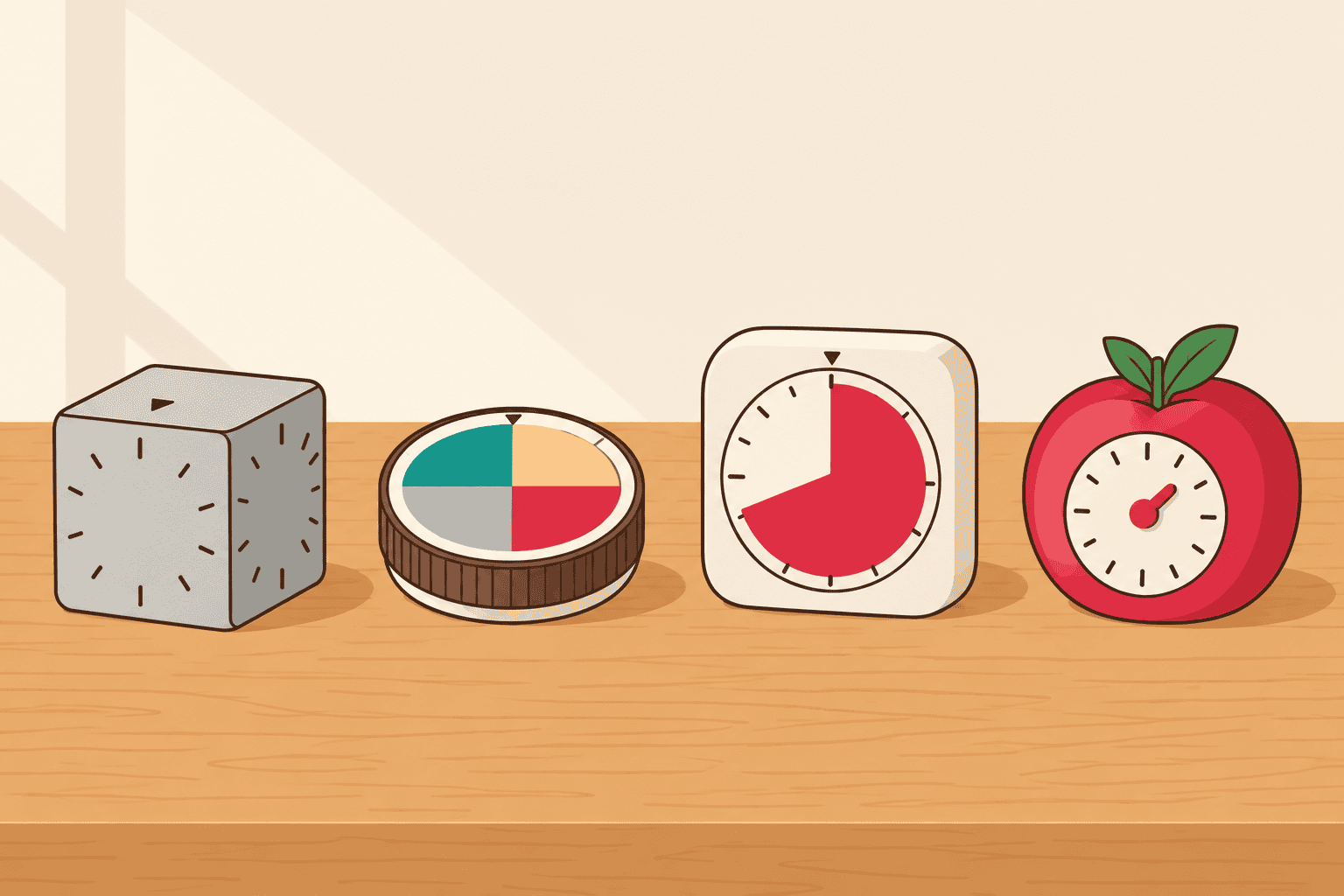
Ticktime T6 Pomodoro Timer Cube
Best for the purpose-built pick. Flip the cube onto a preset face (3, 5, 10, 15, 25 or 30 minutes) and it starts counting straight away, with no screen involved at any point. It’s the priciest of the five here, and the most obviously purpose-built. Check the Ticktime T6 on Amazon.
Rotating Productivity Timer (5/25/10/50)
Best value. It’s Amazon’s “Overall Pick” for pomodoro timers, it uses the same flip-to-start idea as the cube, and its faces are literally 25 and 5, so the method is built into the hardware. Check the rotating productivity timer on Amazon.
Time Timer Home MOD
Best visual, and the quietest. Instead of digits it shows a red disc that shrinks as time passes, so you can read how much is left without doing arithmetic, and the alert can be silenced completely. It’s the most-reviewed of the bunch by a wide margin, and the one I’d suggest for a quiet room or for anyone who finds a ticking countdown stressful. Check the Time Timer Home MOD on Amazon.
Secura 60-Minute Visual Countdown Timer
Best for a shared desk. The dial is an oversized 7.5 inches with a magnetic back, which makes it readable from across a room and happy to live on a fridge door. Good for a study group or a family kitchen. Check the Secura visual timer on Amazon.
Tomato Mechanical Kitchen Timer
Cheapest, and the literal pomodoro. Honest warning: it’s a basic wind-up, it ticks, and it isn’t precise, which its middling rating reflects. Buy it as the cheapest possible way to test whether the method suits you, not as the best timer on this list. Check the tomato kitchen timer on Amazon.
The free apps worth trying
If you’d rather spend nothing, Forest, Focus To-Do, Session, Be Focused and Toggl Track all run the cycle for you, and Forest’s growing-tree gimmick genuinely does make putting the phone down feel like something. Just be honest about whether opening an app on the device that distracts you holds up past week two.
Run one today, judge it on Friday
Don’t decide whether the Pomodoro Technique works by reading about it. Set 25 minutes on whatever timer is closest, pick one task, and see what the week looks like on Friday. If 25 is wrong for you, change it. That’s allowed, and it’s the whole point.
And once you’ve protected that focus time, it’s worth protecting it from busywork too. That’s the job I built the Text Summarizer for, so if long reading is what eats your sessions, try my free AI tools to automate the mundane and keep those 25 minutes for the thinking.
FAQ
Why is it called the Pomodoro Technique?
Because pomodoro is Italian for tomato. Francesco Cirillo timed his study sessions with a tomato-shaped kitchen timer as a university student in the late 1980s, and the name stuck to the method long after the timer itself stopped being the point.
What should I do during the 5-minute break?
Move, mostly. Stand up and stretch, refill your water, step outside for a minute of daylight, or wash up the mug that’s been on your desk since morning. Small physical resets work better than anything that pulls you into a new stream of information, because the point is to change what you’re paying attention to.
Can I just use my phone as a Pomodoro timer?
Yes. If you’d rather not buy anything, put it in airplane mode before you start, set up a focus mode that only lets the timer through, or run the countdown on your laptop and leave the phone in another room. Starting a session shouldn’t mean unlocking your biggest distraction.
What is the Flowtime technique?
Flowtime drops the fixed interval. You work until you genuinely need a break rather than until a bell rings, then take a break roughly proportional to the time you just worked, around 20% of it. It’s the alternative you’ll likely switch to when the rigid 25/5 cycle keeps cutting you off mid-thought.
How many pomodoros should I do in a day?
There’s no evidence-backed number, so don’t chase one. Start with two or three on the days you need them, and let the count follow the work rather than setting a target and feeling bad about missing it. Four good pomodoros beat eight resentful ones.